
admin, Author at Pioneer Property - Page 12 of 14

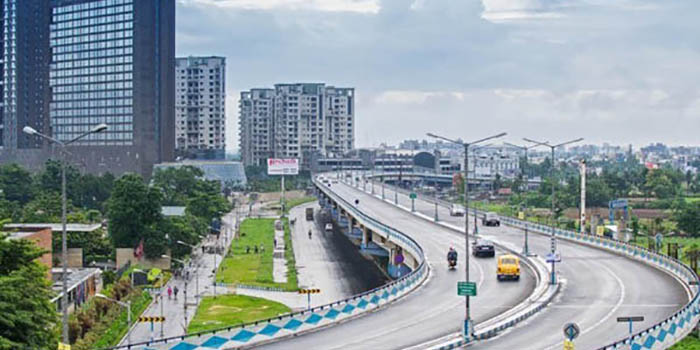
EM Bypass: One of Kolkata’s Premier Real Estate Hotspots

EM bypass is the lifeline of Kolkata. Operational from the year 1982, the 29 Km thoroughfare stretches from Ultadanga, a bustling marketplace demarcating the limit of Kolkata district in the north to Kamalgazi, a serene suburb near Garia, one of the most popular areas in South Kolkata. Kolkata’s longest flyover i.e. Maa flyover runs just over and it will witness the metro connectivity from Garia to Airport.

 Locality & Neighborhood

Apart from connecting the north and south Kolkata, EM Bypass gives seamless access to Kolkata’s IT hubs of Salt Lake and Rajarhatand Newtown in the east. The stretch is divided into three main parts i.e. northern part (from Chingrighata that connects with east Kolkata to Ultadanga), central part (from Chingrighata to Ruby) and southern part(from Ruby to Kamalgazi). In the central part, Park Circus Connector is also another important thoroughfare that connects with EM Bypass and has gained importance gradually. Over the years, EM Bypass has transformed into a residential paradise as well as emerged as an important zone of commercial interest.

The northern part of EM Bypass leverages the synergy in terms of prominent retail concentration and various important establishments like hospitals. This stretch has mainly developed into a premium residential zone. The central part nestles posh hotels, restaurants, areas of scientific importance (Science City), schools and connectivity with commercial hubs. This area is also for the premium segment but MIG (Middle Income Group) customers also have good residential options. The southern stretch is recognized for renowned hospitals, retail concentration, and affordable and mid-affordable housing.

Connectivity

Connectivity plays a pivotal role in strengthening the areas’ overall pulse. The following are the connectivity highlights.

– Chingrighata Crossing
– Ruby Crossing
– Science City Crossing
– Parama Island More
– Hudco Crossing
– Park Circus Connector
– Science City
– Maa flyover
– Upcoming Garia-Airport Metro connectivity
– Yuva Bharati Krirangan (Salt Lake Stadium)

Hotels

EM Bypass proudly flaunts some lavish international standard hotels. The following are the same.

– JW Mariott
– ITC Sonar
– Hyatt Regency

Healthcare

EM bypass has a plethora of renowned hospitals and medical facilities. The following are some of the renowned hospitals.

– Apollo Gleneagles Hospital
– Fortis
– Desun Hospital
– Ruby General Hospital
– RN Tagore International Institute of Cardiac Sciences
– Peerless Hospital
– Hindusthan Hospital
– Sankara Netralaya
– AMRI
– Medica Supercialty Hospital

Restaurant

– Oh! Calcutta
– Mainland China
– Hoppipola
– Chillis
– Byepass Dhaba
– Buddha Bites
– Sigree
– Arsalan
– Rang De Basanti Dhaba

Education

– Calcutta International School
– Techno Model School
– Satyajit Ray Film Institute
– Indus Valley World School
– Calcutta Public School
– The Heritage School
– Delhi Public School Ruby Park
– Radcliffe School
– Kidzee Tagore Park
– Indian Institute of Planning and Management
– KK Das College
– Sammilani Mahavidyalay
– Institute of Business Management and Research
– Techno India DAMA
– West Bengal National University of Juridical Sciences

Malls & Markets

– Metro Cash & Carry
– Metropolis Mall
– Unnayan
– Mani Square


Disclaimer : Information contained and transmitted by us are for information purposes only. All views and/or recommendations are those of the concerned author personally and made purely for information purposes. Nothing contained in the articles should be construed as business, legal, tax, accounting, investment or other advice or as an advertisement or promotion of any project or developer or locality. Pioneer Property Management Ltd. does not offer any such advice. No warranties, guarantees, promises and/or representations of any kind, express or implied, are given as to (a) the nature, standard, quality, reliability, accuracy or otherwise of the information and views provided in (and other contents of) the articles or (b) the suitability, applicability or otherwise of such information, views, or other contents for any person’s circumstances. We shall not be liable nor shall be held responsible in any manner for any action taken based on the published information (whether in law, contract, tort, by negligence, products liability or otherwise) for any losses, injury or damage (whether direct or indirect, special, incidental or consequential) suffered by such person as a result of anyone applying the information (or any other contents) in these articles or making any investment decision on the basis of such information (or any such contents), or otherwise. The users should exercise due caution and/or seek independent advice before they make any decision or take any action on the basis of such information or other contents.


Why Howrah Offers an Attractive Opportunity for Both Investors and Buyers?

Situated on the western banks of Hooghly River, the roots of Howrah district dates back to 500 years. Howrah district has been one of the favorite industrial destinations from British rule. In the current scenario, it is a twin city of Kolkata and is home to the Bengal Secretariat. Howrah is also known worldwide for the famous Howrah Bridge as well as Second Hooghly Bridge or Vidyasagar Setu (longest cable-stayed bridge in India) which can be regarded as its identity.

Locality & Neighbourhood

The twin city of Howrah is known for its industrial concentration. Over the years, development has been widespread uplifting the areas’ aesthetics to the core. Connectivity above all is the most essential factor for infrastructure development in Howrah. With the iconic Howrah Bridge (Rabindra Setu), Second Hooghly Bridge (Vidyasagar Setu) and suburban railways connecting Howrah with Kolkata, vital links like G.T. (Grand Trunk) Road, Grand Foreshore Road, Kona Expressway, Amta Road, Andul Road, NH-2 and NH-6 also intertwine the city providing hassle-free access to Kolkata and adjoining areas.

This directly wires to the active growth of the residential and commercial real estate market of Howrah. Living standards of the people have upgraded and they are gradually internalizing the trend of living in large gated communities that are studded with modern amenities and specifications as against the crowded and congested homes with no such facilities. Reputed developers of Kolkata are also responding to the demand and are coming up with big developments.

Foreign investments which were long outstanding have also been injected into the area for rapid infrastructure development. Recently with the proposed east-west metro corridor from Salt Lake to Howrah Maidan on the development pipeline has lured market sentiments signaling healthy price appreciation of properties in the short to medium run. Investors are finding this as an ideal time to invest and obtain optimal ROIs.

Connectivity

– Howrah Bridge
– Vidyasagar Setu (2nd Hooghly Bridge)
– Upcoming East-west Metro
– Kona Expressway
– NH-6 (Bombay Road)
– NH-2 (Delhi Road)
– Foreshore Road
– Andul Road
– Amta Road
– Howrah Station
– Santragachi station
– Bally Railway Station

Entertainment

– PVR Cinemas, Avani Riverside Mall
– Inox, Forum Rangoli

Healthcare

– Alpha Medical
– Upcoming ILS Hospital
– Narayana Superspeciality Hospital
– Howrah Lions Hospital
– West Bank Hospital

Education

– St. Agnes’ Convent Schools
– Don Bosco School
– MC Kejriwal Vidyapeeth

Malls & Markets

– Howrah AC Market
– Salkia AC Market
– Forum Rangoli

Disclaimer : Information contained and transmitted by us are for information purposes only. All views and/or recommendations are those of the concerned author personally and made purely for information purposes. Nothing contained in the articles should be construed as business, legal, tax, accounting, investment or other advice or as an advertisement or promotion of any project or developer or locality. Pioneer Property Management Ltd. does not offer any such advice. No warranties, guarantees, promises and/or representations of any kind, express or implied, are given as to (a) the nature, standard, quality, reliability, accuracy or otherwise of the information and views provided in (and other contents of) the articles or (b) the suitability, applicability or otherwise of such information, views, or other contents for any person’s circumstances. We shall not be liable nor shall be held responsible in any manner for any action taken based on the published information (whether in law, contract, tort, by negligence, products liability or otherwise) for any losses, injury or damage (whether direct or indirect, special, incidental or consequential) suffered by such person as a result of anyone applying the information (or any other contents) in these articles or making any investment decision on the basis of such information (or any such contents), or otherwise. The users should exercise due caution and/or seek independent advice before they make any decision or take any action on the basis of such information or other contents.
Kolkata is one of India’s Most Livable Metro Cities

Kolkata (also called the city of joy’) is the cultural capital of India and one of the oldest metropolitan cities of India. Simultaneously, it draws significant attention as one of the most livable metro cities in India.

![Kolkata is one of India’s Most Livable Metro Cities](https://i.ibb.co/q0BjBbc/Kolkata.jpg “enter image title here”)

In general, Cities can be envisaged as a kernel of productivity as well as opportunities. With this, the Indian metro cities can be visualized as a testing ground for infrastructure development, cultural progress, fostering of civic amenities, livability index, and expansion of housing and so on.

For the nation’s smart economic growth, the metro cities also act as chief investment basin for players from the nation as well as from abroad. Kolkata stands at the forefront of all of these and evolves as a leading metropolitan city pioneering in livability. There are myriad reasons that can be attributed to the same.

### Safety at its best

Kolkata is the safest city to live in India. As per recent reports from the National Crime Records Bureau, Kolkata is the safest city in terms of crime against women. The government has also internalized a ‘zero tolerance’ approach towards crime against women.

As a direct corollary, the incidents of crime against women are significantly declining. As opposed to the capital city Delhi where the crime rate is higher, Kolkata takes the full pride to provide its citizens a foolproof safety net and makes it one of the peaceful places to live in India.

### Unparalleled affordability

Despite being a metropolitan city, Kolkata is the best and cheapest city to live in India. The cost of living in Kolkata is minimal as compared to other metro cities and this drives people from across India to come and settle here. In terms of food, accommodation, and transport, the city offers you maximum affordability.

You don’t have to worry about real estate prices if you wish to settle down in Kolkata. As per recent research reports, Kolkata has the lowest average capital values as compared to other metro cities. The affordable housing segment below is Rs. 40 lakhs in maximum demand here. In comparison, in cities like Mumbai and Bengaluru, the average ticket size of a 2BHK apartment is Rs. 65 lakhs.

If you are visiting Kolkata, you are in luck because it won’t hurt your pocket. Travelling in metro rail is cheaper here than any other metros. You will also find an array of other cost-effective transport modes like auto, trams, rickshaws, and ferries among others. Nowhere in any metro cities of India will you find local transport this cheap.

### Robust development

Kolkata is developing at a rapid pace and in the current scenario, it is one of the top developed cities in India. As per the report by a London based global management consulting group AT Kearney, Kolkata is one of the fastest-growing cities of the world based on parameters like business activities, human capital, exchange of information, cultural experience and political engagement.

Recently, the Bengal Government has sanctioned Rs. 18,000 crores for infrastructure development projects. This includes flyover construction, roads and bridges, power, drinking water, irrigation and affordable housing. Big IT companies are also coming to the city to expand their operations thereby creating new job opportunities in the city.

### Cultural extravaganza

Kolkata has a unique ethos. It is a city where contemporary hues and heritage seem to amalgamate considerably. Kolkata has been at the epicenter of the cultural renaissance that ushered in India in the 19th century. Who does not know the Nobel Laureate and luminary of Indian literature Rabindranath Tagore whose path-breaking work in poetry, music, and painting resonates in the city till date with the utmost vigor.

Famous authors like Sarat Chandra Chattopadhyay, Sunil Gangopadhyay, Bankim Chandra Chattopadhyay and so on are bright stars on the sky of Bengali literature. If you think about music, the immediate thing that will strike your mind is Rabindra Sangeet. Tagore composed more than 2000 songs that are uniquely intrinsic to the culture of Kolkata. Ravi Shankar, another music maestro is associated with Kolkata through thick and thin.

The famous dancer Uday Shankar who has taken the stance of amalgamating western and Indian dance forms had Kolkata as his stage. The contribution of Kolkata to the trajectory of Hindi music has been phenomenal. Legends like Kishore Kumar, S.D. Burman, R.D. Burman, and Manna Dey have significantly enriched Indian film music with their dynamic contribution.

Festivals are the heart and soul of Kolkata. During its festivals, the city comes alive in vibrant colors. If you are in Kolkata, the one festival you cannot afford to miss is the Durga Puja. Durga Puja is Kolkata’s biggest festival where the whole city oozes out with great joy and celebration. People from all over the world come to Kolkata to witness this one of a kind extravaganza.

In essence, Kolkata with its awe-inspiring attributes can be contemplated as elements of great living. So come and dwell in Kolkata.

Disclaimer : Information contained and transmitted by us are for information purposes only. All views and/or recommendations are those of the concerned author personally and made purely for information purposes. Nothing contained in the articles should be construed as business, legal, tax, accounting, investment or other advice or as an advertisement or promotion of any project or developer or locality. Pioneer Property Management Ltd. does not offer any such advice. No warranties, guarantees, promises and/or representations of any kind, express or implied, are given as to (a) the nature, standard, quality, reliability, accuracy or otherwise of the information and views provided in (and other contents of) the articles or (b) the suitability, applicability or otherwise of such information, views, or other contents for any person’s circumstances. We shall not be liable nor shall be held responsible in any manner for any action taken based on the published information (whether in law, contract, tort, by negligence, products liability or otherwise) for any losses, injury or damage (whether direct or indirect, special, incidental or consequential) suffered by such person as a result of anyone applying the information (or any other contents) in these articles or making any investment decision on the basis of such information (or any such contents), or otherwise. The users should exercise due caution and/or seek independent advice before they make any decision or take any action on the basis of such information or other contents.

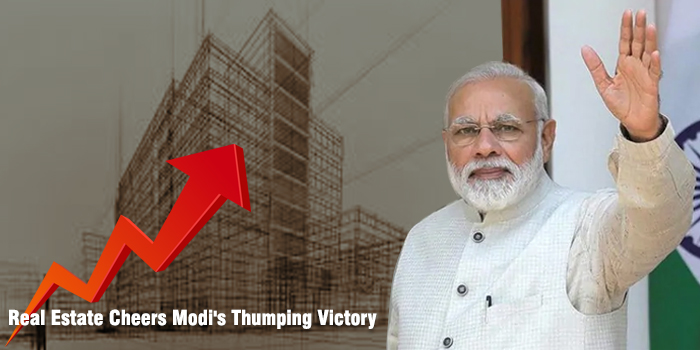
Real Estate Industry Cheers Modi’s Thumping Victory

Expressing certainty over Government’s strategic real-estate initiatives, sector hailed the stupendous victory of Narendra Modi-led NDA government in General Elections 2019 as a vote for growth and development.

Citing initiatives such as “RERA”, “GST” as well as ‘Affordable Housing’ all into action by ending in 2022, the sector expects institutional-specific investments to a high double-digit as much as $10 billion by the end of fiscal 2019.

The potentiality of reforms also being reflected in form of investments reaped by the Real Estate sector, out of the institutions’ total investment of $30 bn during 2009-2018,$20 bn was being invested between 2014-2018. In the same period, the foreign direct investments share more than doubled to 70% in 2018 from 32% in 2009.

In addition, the country soon likely to witness fresh REIT launches. Constructive REITs made bold reforms since July 2014 deliver a successful listing of India’s REITs. The world’s leading real estate advisory firm JLL had anticipated that Indian office space – now holds huge potential with high ROIs.

– Under Pradhan Mantri Awas Yojana [PMAY], over 6.85 Million houses being sanctioned in Dec. 2019
– In Feb. 2018, the conception of National Urban Housing Fund (NUHF) had been approved with a budget outlay of 60K crores (US$ 17.5 billion)
– Under Pradhan Mantri Awas Yojana [PMAY], 1,426,485 houses had been sanctioned in the year 2017-18. In Mar 2018, the conception of an additional 3, 20,556 affordable houses being sanctioned under this scheme.
– Nearly 5.1 million sq. ft. of office space became fully operational against the top seven major cities in 2018.

During Modi’s first term, the government gave a decisive impetus unfolding all-around infrastructural development, great policy overhauls like DeMo, GST and RERA, amended previous Acts such as Insolvency and Bankruptcy Code (IBC) along with other envisioned schemes including Housing for all, 100 Smart Cities, AMRUT Cities, Make in India and so forth.

With Modi 2.0, we see fairly robust momentum most recently would not only maintain a pace of growth but also escalate speed. Some of these governments’ initiatives undoubtedly will sail through to the conclusive stage of their journey.


Disclaimer : Information contained and transmitted by us are for information purposes only. All views and/or recommendations are those of the concerned author personally and made purely for information purposes. Nothing contained in the articles should be construed as business, legal, tax, accounting, investment or other advice or as an advertisement or promotion of any project or developer or locality. Pioneer Property Management Ltd. does not offer any such advice. No warranties, guarantees, promises and/or representations of any kind, express or implied, are given as to (a) the nature, standard, quality, reliability, accuracy or otherwise of the information and views provided in (and other contents of) the articles or (b) the suitability, applicability or otherwise of such information, views, or other contents for any person’s circumstances. We shall not be liable nor shall be held responsible in any manner for any action taken based on the published information (whether in law, contract, tort, by negligence, products liability or otherwise) for any losses, injury or damage (whether direct or indirect, special, incidental or consequential) suffered by such person as a result of anyone applying the information (or any other contents) in these articles or making any investment decision on the basis of such information (or any such contents), or otherwise. The users should exercise due caution and/or seek independent advice before they make any decision or take any action on the basis of such information or other contents.

Over 34,000 Industrial Projects Registered in Breach of RERA Across India

“Total 15 states/UTs already set up standard RERA (Real Estate Regulatory Authority) while 13 hold interim RERA

Over 34,891 ongoing real-estate projects and 27,072 independent real-estate agents, being registered through ‘RERA’ across India till now, as per housing & urban affairs Report.

For now, 28 out of 35 states & union territories (UTs) have officially notified legislations under ‘RERA’ while the West Bengal geared up to enact its own law e.g. ‘HIRA’ (Housing & Industrial Regulation Act, 2017). However, the state is being instructed for notifying the regulations under the real-estate [Regulation & Development] Act 2016.

Jammu and Kashmir, among six North-eastern states e.g. Manipur, Arunachal Pradesh, Mizoram, Meghalaya, Sikkim, and Nagaland have not yet been notified the legislation under ‘RERA’.

A total of 15 States, UTs have officially set up standard ‘RERA’ (Real Estate Regulatory Authority) while 13 holds interim RERA. However, Nine states, UTs have established interim Real-Estate appellate tribunal, informed by the ministry.


Disclaimer : Information contained and transmitted by us are for information purposes only. All views and/or recommendations are those of the concerned author personally and made purely for information purposes. Nothing contained in the articles should be construed as business, legal, tax, accounting, investment or other advice or as an advertisement or promotion of any project or developer or locality. Pioneer Property Management Ltd. does not offer any such advice. No warranties, guarantees, promises and/or representations of any kind, express or implied, are given as to (a) the nature, standard, quality, reliability, accuracy or otherwise of the information and views provided in (and other contents of) the articles or (b) the suitability, applicability or otherwise of such information, views, or other contents for any person’s circumstances. We shall not be liable nor shall be held responsible in any manner for any action taken based on the published information (whether in law, contract, tort, by negligence, products liability or otherwise) for any losses, injury or damage (whether direct or indirect, special, incidental or consequential) suffered by such person as a result of anyone applying the information (or any other contents) in these articles or making any investment decision on the basis of such information (or any such contents), or otherwise. The users should exercise due caution and/or seek independent advice before they make any decision or take any action on the basis of such information or other contents.
Singapore Investors’ Massive Bet on India’s Realty Sector

– Singapore-based PE firms pumped a total of $3.5 billion in 2017-2018 into Indian real estate.

– Major players such as GIC, Xander, Ascendas-Singbridge are in the process of funneling several billion dollars into the country’s realty sector.

Singapore-based PE’ investors already started betting big over India’s property market along with various other emerging sectors, including warehousing and logistics.

Major PE players including GIC, Xander and Ascendas-Singbridge are investing multi-billion dollars across the country’s realty sector, specifically, in its south Indian cities.

Around 1/3rd of the country’s total PE’ investments amounting $14 billion in the realty sector done by Singaporean based firms, all-time highest across both domestic/foreign investors.

Under tight funding situation in banks and NBFCs (nonbanking finance companies), Indian realty developers apparently being compelled to explore more debt/equity funding across various (PE) firms. Singapore-based investors were ranked among the top in the list, accompanied by private equity (PE) players from the USA, Canada, and Mexico. After setting up a solid base in greater China, India is emerging as one of the preferred destinations for investors.

A mix of high-performing Singapore projects have established a robust foothold in India’s commercial market over the past few years, through their tolerant and long-run outlook. Over $1.15 billion was invested into India’s real-estate sector back in 2015-2016, and around $3.5 billion in 2017-2018. In recent times, they are also aiming to expand their portfolios and scrutinizing emerging markets including warehousing and logistics. In the last few years, GIC invested more than $2.5 billion, aiming significant cities such as Chennai, Mumbai, Hyderabad, Bangalore, and NCR.


Disclaimer : Information contained and transmitted by us are for information purposes only. All views and/or recommendations are those of the concerned author personally and made purely for information purposes. Nothing contained in the articles should be construed as business, legal, tax, accounting, investment or other advice or as an advertisement or promotion of any project or developer or locality. Pioneer Property Management Ltd. does not offer any such advice. No warranties, guarantees, promises and/or representations of any kind, express or implied, are given as to (a) the nature, standard, quality, reliability, accuracy or otherwise of the information and views provided in (and other contents of) the articles or (b) the suitability, applicability or otherwise of such information, views, or other contents for any person’s circumstances. We shall not be liable nor shall be held responsible in any manner for any action taken based on the published information (whether in law, contract, tort, by negligence, products liability or otherwise) for any losses, injury or damage (whether direct or indirect, special, incidental or consequential) suffered by such person as a result of anyone applying the information (or any other contents) in these articles or making any investment decision on the basis of such information (or any such contents), or otherwise. The users should exercise due caution and/or seek independent advice before they make any decision or take any action on the basis of such information or other contents.

GST Reduction and Its Impact

The GST council has reduced the rates to 5% and 1% on affordable housing from 12% to 8% affordable housing respectively effective from 1st April, 2019. The GST council has also redefined the definition of affordable housing. Units less than 60 square meters (645 square feet) in metropolitian area and 90 square meters (968 square feet) in non-metropolitan area and valuation less than Rs. 45 lakhs would be considered as affordable housing.

Firstly, the GST reduction will narrow down the price gap between under-construction projects and ready projects. This in turn will revive the demand for under-construction properties especially from builders concentrating on lower income groups because now the gap between under-construction and ready properties is just 1%.

The consumer sentiments are expected to rise significantly. As per research data, around 40-45% of ongoing supply in major Indian cities falls below Rs. 45 lakh ticket size. This will stimulate the demand of end users and will gradually improve market liquidity.

The pricing strategy is an important dimension here. If one thinks that the price will decrease significantly then it will be a misunderstanding. The developers will not receive input credit now as against earlier. The builders will recalibrate the base price of their projects to compensate for the loss of input tax credit. Thus, the effective price will rise up. The buyers can make their purchasing decision now.

Disclaimer : Information contained and transmitted by us are for information purposes only. All views and/or recommendations are those of the concerned author personally and made purely for information purposes. Nothing contained in the articles should be construed as business, legal, tax, accounting, investment or other advice or as an advertisement or promotion of any project or developer or locality. Pioneer Property Management Ltd. does not offer any such advice. No warranties, guarantees, promises and/or representations of any kind, express or implied, are given as to (a) the nature, standard, quality, reliability, accuracy or otherwise of the information and views provided in (and other contents of) the articles or (b) the suitability, applicability or otherwise of such information, views, or other contents for any person’s circumstances. We shall not be liable nor shall be held responsible in any manner for any action taken based on the published information (whether in law, contract, tort, by negligence, products liability or otherwise) for any losses, injury or damage (whether direct or indirect, special, incidental or consequential) suffered by such person as a result of anyone applying the information (or any other contents) in these articles or making any investment decision on the basis of such information (or any such contents), or otherwise. The users should exercise due caution and/or seek independent advice before they make any decision or take any action on the basis of such information or other contents.

Compact Homes: New way of Living

Way of living is changing dramatically and in the current scenario compact home is the new trend. One of the growth drivers of compact homes is young population who are contributing significantly to the GDP of the nation.

Today, some of the top aspirations of Gen Y include home-ownership. Surplus disposable income, ease of availing home loan and the importance given to personal space, have fuelled their dream of owning a home. That was not the case a few decades back. This generation’s need for a home is quite different from that of the previous generations. Their specifications are simple – a compact abode, which takes care of their requirements; a home that is located at a striking distance of all amenities and facilities, and more importantly, a residential unit that doesn’t go burden their wallets.

Compact homes perfectly match the requirements, such as privacy and desire to own a home within the budget of the Gen Y. This trend has contributed to the dimensional changes to existing homes, as the demand for studio, 1 BHK and 1.5 BHK homes in metros are soaring.

In metros, single working professionals, especially are opting for either shared accommodation, apartments (2bhk and 3bhk) or paying guest facilities. Married couples tend to rent homes a little far away from their workplaces (because of the high rents in CBD and economic hubs). Investing in a compact house offers dual benefits – Firstly, they save on the rent being paid. Secondly, the new home is an investment instrument because of returns annually on account of appreciation of capital values of the property. The ROI will be useful when the property owner plans to buy a bigger house (in the latter part of his/her career/life). From an investment perspective too, it is a profitable proposition, as one can gain from the rental income.

In the last five to eight years, there has been a substantial increase in urban migration in India as the Gen Y is relocating to different cities in search of better job opportunities and livelihood. IT/ITeS is the main driving force and most of the buyers are below 30 years. As most investments are funded by home loans, smaller apartments mean that EMI outflows are manageable. Smaller homes also have lower maintenance costs.

In essence, compact home is the new buzzword and its market will only grow bigger in the coming years. With more awareness, long term benefits and better resale value, compact housing will emerge as a stronger segment.

_Image Courtesy:home-designing.com_

Disclaimer : Information contained and transmitted by us are for information purposes only. All views and/or recommendations are those of the concerned author personally and made purely for information purposes. Nothing contained in the articles should be construed as business, legal, tax, accounting, investment or other advice or as an advertisement or promotion of any project or developer or locality. Pioneer Property Management Ltd. does not offer any such advice. No warranties, guarantees, promises and/or representations of any kind, express or implied, are given as to (a) the nature, standard, quality, reliability, accuracy or otherwise of the information and views provided in (and other contents of) the articles or (b) the suitability, applicability or otherwise of such information, views, or other contents for any person’s circumstances. We shall not be liable nor shall be held responsible in any manner for any action taken based on the published information (whether in law, contract, tort, by negligence, products liability or otherwise) for any losses, injury or damage (whether direct or indirect, special, incidental or consequential) suffered by such person as a result of anyone applying the information (or any other contents) in these articles or making any investment decision on the basis of such information (or any such contents), or otherwise. The users should exercise due caution and/or seek independent advice before they make any decision or take any action on the basis of such information or other contents.

Home Automation: Commands & Responses

Today everything is automated and home automation is the new buzz word. A home automation system is an integral part of a smart home that controls lighting, climate, entertainment systems and appliances to give life impeccable comfort. One of the most interesting features is that home automation works on your commands.

Home Automation: Commands & Responses Electrical gadgets & energy savings
Home automation systems have proved to be extremely useful when it comes to energy savings. One can easily pre-program the temperature of the day or week, adjust lighting settings, control volume of the audio-video system, and calibrate the content of the television and so on via internet enabled devices. Although, energy savings depend eventually depend on the type of the device being used and its automation capabilities, on an average it is estimated that consumers can save anywhere from 10 to 15% off of heating and cooling bills.

Enhanced security
Security is of utmost importance and home automation enhances security. Through internet enabled security system, home automation system not only connect the main door but also all other openings of the house to provide comprehensive security. A homeowner can have live feed of a specific area in the home. On any sort of intrusion, the system would intimate the homeowner via sms or email or voice call or sound hooter and intimate security personnel at the gate. The automation systems can be also coupled with safety sensors such as smoke detectors and gas leak detectors.

Sustainability
The response of home automation also adds to the sustainability. Through the systems, energy consumption can be regulated. Automated homes have multiple sensors that monitor ambient light and air temperature and accordingly alter the settings of electrical gadgets. This would regulate energy use by automatically engaging systems when needed and disengaging them when the parameters are satisfied. Air conditioner for example is turned on when temperature goes up and automatically turns off when temperature is reduced to the required level.

Costs hardly matters
Cost is one of the major parameters that need to be taken into consideration. Nonetheless, though a smart home will cost 20% more than a conventional one, however, the former pays for itself within a few years via savings accruing from less use of power and other resources.

Disclaimer : Information contained and transmitted by us are for information purposes only. All views and/or recommendations are those of the concerned author personally and made purely for information purposes. Nothing contained in the articles should be construed as business, legal, tax, accounting, investment or other advice or as an advertisement or promotion of any project or developer or locality. Pioneer Property Management Ltd. does not offer any such advice. No warranties, guarantees, promises and/or representations of any kind, express or implied, are given as to (a) the nature, standard, quality, reliability, accuracy or otherwise of the information and views provided in (and other contents of) the articles or (b) the suitability, applicability or otherwise of such information, views, or other contents for any person’s circumstances. We shall not be liable nor shall be held responsible in any manner for any action taken based on the published information (whether in law, contract, tort, by negligence, products liability or otherwise) for any losses, injury or damage (whether direct or indirect, special, incidental or consequential) suffered by such person as a result of anyone applying the information (or any other contents) in these articles or making any investment decision on the basis of such information (or any such contents), or otherwise. The users should exercise due caution and/or seek independent advice before they make any decision or take any action on the basis of such information or other contents.

Millennials Revolutionizing Home Buying

A millennial is a person who is born in the early 1980s or in the mid-1990s. The average age of a millennial group is 30 years. As per research reports, millenials constitute of 36% of first-time home buyers. In the current scenario, the millennials are revolutionizing home buying. There are several reasons.

 Tech Savvy
Unlike earlier generations, millennials grew up in a digital world, starting with cell phones and computers and progressing to social media, transaction-enhancing apps and artificial intelligence. Growing up in such an environment means access to instant information is fundamental. This extends to home buying as they educate themselves online thoroughly and use more resources to research before making a decision.

More educated & higher disposable income
The millenials are more educated than their previous generation. Millennials are more likely than ever to have a bachelor’s degree. Both men and women are now more likely to hold bachelor degrees compared to their Gen X counterparts. As a corollary, their disposable income is also high and this helps them to manage their finances properly.

Longer stay
Many millennials also plan to stay in their first homes much longer than baby boomers stayed in their first homes. The time and money most spent searching for the ideal neighborhood and making their home perfect for their growing family needs means they’re quite comfortable staying where they are long term.

Optimum sizing
Sizing matters significantly for the millenials. The demand for compact homes or smaller sized apartments is high among them. The obvious reason is that they are getting married late and they prefer smaller family size. But they do not compromise on the quality. They do not mind spending the extra bucks to get what they need in a compact home.

Disclaimer : Information contained and transmitted by us are for information purposes only. All views and/or recommendations are those of the concerned author personally and made purely for information purposes. Nothing contained in the articles should be construed as business, legal, tax, accounting, investment or other advice or as an advertisement or promotion of any project or developer or locality. Pioneer Property Management Ltd. does not offer any such advice. No warranties, guarantees, promises and/or representations of any kind, express or implied, are given as to (a) the nature, standard, quality, reliability, accuracy or otherwise of the information and views provided in (and other contents of) the articles or (b) the suitability, applicability or otherwise of such information, views, or other contents for any person’s circumstances. We shall not be liable nor shall be held responsible in any manner for any action taken based on the published information (whether in law, contract, tort, by negligence, products liability or otherwise) for any losses, injury or damage (whether direct or indirect, special, incidental or consequential) suffered by such person as a result of anyone applying the information (or any other contents) in these articles or making any investment decision on the basis of such information (or any such contents), or otherwise. The users should exercise due caution and/or seek independent advice before they make any decision or take any action on the basis of such information or other contents.