

admin, Author at Pioneer Property - Page 9 of 14

Simple home-improvement solutions

We often wonder how to give our home a makeover without spending a fortune on total overhaul. Well, all you need to do is to settle on some overarching theme and let your creative juices flow. The tiniest of DIY changes can sometimes have a huge impact and make your old home look sparkling new. It just requires a little bit of work and of course your bright ideas.

Here are some simple tips to make your home look better:

# Go for a fresh coat of paint: You will be surprised what a fresh coat of paint can do to lift your old home. You can try an accent wall on your living room or bedroom and go for a painted ceiling. While at it, repainting your kitchen cabinet isn’t a bad idea.

# Replace old fixtures: Replacing old light fixtures and ceiling fans with new, contemporary-design fittings can have a dramatic impact. Cutting-edge designs are easily available these days and with the wiring already in place, old fixtures can be easily replaced.

# Swap white light with yellow: While on light fixtures, replacing the white bulbs in your home with calming yellow ones is another simple trick that can bring about a significant transformation in the ambience of your home and impart a pleasant yellow glow. Also, replacing standard light switches with dimmers can enable you to control the brightness and set the mood.

# Maximize unused corners: We all have nooks and corners in our home which lie largely unused. A simple DIY solution is putting up some simple floating shelves in those corners. Not only will you have extra storage space, it will enhance the look and feel and liven up your home.

# Refurbish old furniture: We often feel tired of the looks of our same old furniture which are otherwise in perfect working condition. Simple DIY solutions like painting, reupholstering and altering their placements can make those look bright and new again.

# Bring in the green: Install potted plants and flowers to freshen up your home and add a dose of greenery and vitality to your home. There are certain tough plant species which don’t require too much care and watering, in case you are short on time.

# Do up the entrance: While this area is perhaps the most used, it often remains neglected as being just the means of entry and egress. However, simple upgrades like putting up a few paintings on the walls, placing a bench or throwing in a new rug can work wonders to create an impactful impression for those stepping in.

# Create a pet corner: By creating a special space for your pet, you not only give them excitement and gratification, it also serves to brighten up your home. Some simple additions can include wall-fitted jungle gyms, tiny water fountains, etc.

# Install smart features: These days, you can easily turn your old home into a new smart home by installing some smart features like camera-enabled doorbells, self-programmable thermostats and many more such smart gadgets readily available.

# Cut the clutter: Unseemly chords hanging from your TV monitor or tangled in a messy branch behind your amplifier and speakers can really exude a sense of ugly clutter. There are simple DIY solutions to dress up these loose-dangling wires into an organized bunch and stow them away out of sight.

# Install adhesive veneers: These are easy-to-install wall coverings which can impart a sense of texture. Without an extensive overhaul, you can make your home look very new with a different and updated look and feel by using these veneers.

# Give your flooring a makeover: While overhauling the flooring itself can be an expensive affair, there are cheaper and simpler DIY options like changing the floor upholstery, throwing in some rugs and carpets and other soft furnishing for the visible portions like bamboo rugs and weaves.

# Create your own corner: You can dedicate one nook of your home to your passion area, showcasing elements that make up you as a person. Let the pictures/posters on the walls and the pieces of artifacts, etc speak out loud and eloquent to delineate your domain of love. It adds that organic flavour and personal touch to your abode.

# Augment your bathroom space: The bathroom is another oft-neglected space in our home and deemed to be just a utility. Irrespective of the size of your bathroom/s, you can make it look better and bigger. For instance, just installing a large mirror can enhance the sense of space. To relieve boredom and add some colour, you can install motif tiles. New faucets and fittings can also do wonders.

# Put up mirrors on the wall: Mirrors have this amazing ability to usher in more light and make spaces inside your home seem much larger than they actually are. Hanging up some mirrors on walls which you think stand in perhaps a dull section of your home can make magic.

Disclaimer : Information contained and transmitted by us are for information purposes only. All views and/or recommendations are those of the concerned author personally and made purely for information purposes. Nothing contained in the articles should be construed as business, legal, tax, accounting, investment or other advice or as an advertisement or promotion of any project or developer or locality. Pioneer Property Management Ltd. does not offer any such advice. No warranties, guarantees, promises and/or representations of any kind, express or implied, are given as to (a) the nature, standard, quality, reliability, accuracy or otherwise of the information and views provided in (and other contents of) the articles or (b) the suitability, applicability or otherwise of such information, views, or other contents for any person’s circumstances. We shall not be liable nor shall be held responsible in any manner for any action taken based on the published information (whether in law, contract, tort, by negligence, products liability or otherwise) for any losses, injury or damage (whether direct or indirect, special, incidental or consequential) suffered by such person as a result of anyone applying the information (or any other contents) in these articles or making any investment decision on the basis of such information (or any such contents), or otherwise. The users should exercise due caution and/or seek independent advice before they make any decision or take any action on the basis of such information or other contents.


How Green Buildings can benefit occupants

Any structure erected with a conscious eye to reduce and eliminate to the extent possible the critical impacts of rising temperatures and climate change, thus extending positive impact on the environment, is a “green building”. This is achieved through efficient use of resources like water and energy, relying on sustainable and non-toxic materials, using processes of re-using and recycling and an adaptable design, among other methodologies including renewable sources of energy like solar power. Not just reduction of carbon footprints, worldwide, there’s growing evidence of multiple benefits that green buildings can provide to help create sustainable and thriving communities while boosting economic growth.

The global gold standard for green building certification systems is Leadership in Energy and Environmental Design or LEED, which follows a standard metric for all types of buildings through its various phases of construction, besides evaluating interiors, operations and maintenance and core and shell.

LEED has three layers of rating for green buildings, based on their features and design. The ratings are Platinum, Gold and Silver. In India, the certification for “green buildings” is given by the Indian Green Building Council (IGBC), which was formed as part of the Confederation of Indian Industry (CII) in 2001.

What is IGBC Ratings?

The Indian Green Building Council (IGBC), part of the Confederation of Indian Industry (CII) was formed in the year 2001. The vision of the council is, “To enable a sustainable built environment for all and facilitate India to be one of the global leaders in the sustainable built environment by 2025”.

The council offers a wide array of services which include developing new green building rating programmes, certification services and green building training programmes. The council also organises Green Building Congress, its annual flagship event on green buildings.

The council is committee-based, member-driven and consensus-focused. All the stakeholders of construction industry comprising of architects, developers, product manufacturers, corporate, Government, academia and nodal agencies participate in the council activities through local chapters. The council also closely works with several State Governments, Central Government, World Green Building Council, bilateral multi-lateral agencies in promoting green building concepts in the country.

How do occupants benefit from green buildings?

There are multiple ways in which the consumers/occupants benefit from a green building. These are some of the key advantages:

# Reduced maintenance and operation cost: Green buildings ensure efficient use of resources like water and electricity thanks to innovative construction methods. Through optimization of natural light and use of task-lighting strategy, power and water bills are cut by nearly one-third, thus increasing earnings.

# Better energy efficiency: Green buildings are designed to minimize reliance on energy from non-renewable sources like coal. Using solar panels and maximizing natural light with the help of specially designed windows, the use of artificial light is reduced drastically, thus saving on energy bills.

# Improves indoor air quality: By installing operable windows to allow maximum sunlight to filter through and reducing use of harmful and toxic materials, green buildings also offer superior indoor air quality, thus impacting the occupants’ health positively, besides improving illumination, ergonomics and thermal conditions inside the building.

# Enhances water efficiency: Green buildings vastly improve water efficiency by using practices like rainwater harvesting, reducing water wastage by installing efficient plumbing fixtures and deploying systems to purify and recycle waste water.

# Improves occupant health: Occupants of green buildings can enjoy a clutch of health benefits and a better quality of life thanks to the use of safe and sustainable materials, better indoor air quality, ergonomics, etc. Care is taken to avoid using building materials that may contain harmful volatile organic compounds (VOCs) or plastic by-products which could be toxic, sometimes emitting carcinogens which can raise the risk of cancer, respiratory diseases and other health conditions.

# Material efficiency: Green buildings are designed in a manner as to use less materials, water and energy. The materials are durable and the processes generate as little waste as possible, without compromising on the result. Some of the materials used can be recycled and reused.

# Creates better environment: Green buildings have a significant positive impact on the environment by relying more on non-polluting energy sources. By minimizing the levels of carbon dioxide emitted into the atmosphere, such structures can help slow down climate change.

# Eases load on local resources: By using technologies and processes that boost water and energy efficiency, green buildings can reduce the burden on local shared resources.

# More durable: Not only do green buildings offer energy and water savings and better indoor air quality, these structures are more durable as well, since sustainable materials have been proven to last longer. These materials endure for years exposed to the elements, while requiring minimal maintenance.

# Better workplace productivity: According to studies, employees working in green and well-ventilated office buildings are more productive, since they are more focused, have improved cognitive function, get better sleep and fall sick less frequently.

# A future-proof investment: Green buildings are regarded as future-proof investment because of their longevity, adaptability, resilience and capacity to improve the quality of life of its occupants, while positively impacting the environment. The trend will continue to grow, experts feel.

Disclaimer : Information contained and transmitted by us are for information purposes only. All views and/or recommendations are those of the concerned author personally and made purely for information purposes. Nothing contained in the articles should be construed as business, legal, tax, accounting, investment or other advice or as an advertisement or promotion of any project or developer or locality. Pioneer Property Management Ltd. does not offer any such advice. No warranties, guarantees, promises and/or representations of any kind, express or implied, are given as to (a) the nature, standard, quality, reliability, accuracy or otherwise of the information and views provided in (and other contents of) the articles or (b) the suitability, applicability or otherwise of such information, views, or other contents for any person’s circumstances. We shall not be liable nor shall be held responsible in any manner for any action taken based on the published information (whether in law, contract, tort, by negligence, products liability or otherwise) for any losses, injury or damage (whether direct or indirect, special, incidental or consequential) suffered by such person as a result of anyone applying the information (or any other contents) in these articles or making any investment decision on the basis of such information (or any such contents), or otherwise. The users should exercise due caution and/or seek independent advice before they make any decision or take any action on the basis of such information or other contents.

Warehouse automation – the Buzz-phrase

Warehouse automation is the process of substituting repetitive manual tasks with automated systems, the objectives being to minimize labour-intensive work, cut down on time consumed in moving inventory into, within and out of warehouses and free up manpower for more rigorous quality-control.

Warehouse automation can be both digital and physical.

# Digital automation resorts to use of data and software to minimize manual workflows.

# Physical automation uses technology like robots to reduce movement of staff, while building more efficient workflows.

How does automation improve warehouse efficiency?

Adoption of automated systems can result in:

# Reducing human error

# Cutting down on labour

# Improving coordination in material handling

# Improving safety at workplace

# Achieving better inventory control

# Elevating customer service level

# Cutting overall costs

# Increasing throughput

# Improving employee satisfaction

# Enhancing data accuracy & analysis

# Optimizing warehousing space

What are the different types of warehouse automation technology in use?

Warehousing technology aims at minimizing manual tasks, thus speeding up processes in the entire ecosystem, from receiving to shipping. The technologies most in use include: # Warehouse management systems or WMS: These are software applications which help in operations like monitoring, controlling and optimizing day-to-day operations. These operations would typically include inventory tracking, packing and shipping activities and coordinating handling machinery.

# Goods-to-Person: GTP fulfillment is a critical tool to raise efficiency. GTP systems can help increase the speed of warehouse picking manifold by cutting congestion with the help of conveyors, carousels, vertical lifts, etc.

# Automated Storage and Retrieval Systems (AS/RS): AS/RS comprises automated systems and tools like mini-loaders to store and retrieve stuff, vehicles for carrying materials and shuttles. AS/RS is extremely effective in space-constrained high-volume warehouse applications.

# Automatic Guided Vehicles (AGVs): Using magnetic strips, sensors or wires, AGVs navigate a fixed path through the warehouse. AGVs are tailored to serve simple yet large warehouse settings and aren’t suited to complex warehouses with space constraints and heavy human traffic.

# Autonomous Mobile Robots (AMRs): AMRs, on the other hand, can safely navigate through heavy human traffic in complex settings, using laser guidance systems to detect obstacles. These are much more flexible than AGVs, use GPS systems to negotiate routes through a particular warehouse and are easy to programme.

# Pick-to-Light and Put-to-Light Systems: These hi-tech systems direct warehouse pickers accurately to place or pick up specific items, using barcode scanning devices synced to digital light displays, thus minimizing search time and human error drastically.

# Voice Picking and Tasking: Also known as pick-by-voice, this system uses speech identification software and mobile headsets to create optimized pick paths to direct warehouse staff to their destinations for picking or putting away a product very accurately. It ensures improved safety and efficiency since there’s no need to carry handheld devices.

# Automated Sorting Systems: These systems help in fulfilling orders for receiving, picking, packing and shipping of materials by identifying items on a conveyor belt and directing those to a warehouse using barcode scanners, RFID and sensors.

# Predictive Maintenance: Predictive or preventive maintenance systems are designed to monitor equipment to detect possible defects before they occur, rather than having to repair them once there’s a breakdown. These systems take preventive measures by automatically slotting corrective maintenance.

# Fleet Management Systems: This comprises monitoring and managing the company’s vehicles deployed to ensure maximum productivity, while rationalizing operational costs. This is done by collecting and analyzing data from vehicles including speed, fuel consumed, run time, etc.

Disclaimer : Information contained and transmitted by us are for information purposes only. All views and/or recommendations are those of the concerned author personally and made purely for information purposes. Nothing contained in the articles should be construed as business, legal, tax, accounting, investment or other advice or as an advertisement or promotion of any project or developer or locality. Pioneer Property Management Ltd. does not offer any such advice. No warranties, guarantees, promises and/or representations of any kind, express or implied, are given as to (a) the nature, standard, quality, reliability, accuracy or otherwise of the information and views provided in (and other contents of) the articles or (b) the suitability, applicability or otherwise of such information, views, or other contents for any person’s circumstances. We shall not be liable nor shall be held responsible in any manner for any action taken based on the published information (whether in law, contract, tort, by negligence, products liability or otherwise) for any losses, injury or damage (whether direct or indirect, special, incidental or consequential) suffered by such person as a result of anyone applying the information (or any other contents) in these articles or making any investment decision on the basis of such information (or any such contents), or otherwise. The users should exercise due caution and/or seek independent advice before they make any decision or take any action on the basis of such information or other contents.
Importance of Plants inside your House

Indoor plants not only make our house look better, they have the ability to make us feel good as well. Research shows indoor gardening can boost our mood, concentration, creativity and productivity, while reducing stress and fatigue and cleaning indoor air by removing toxins and producing oxygen, thus even promoting recovery

Clearly, plants bring home much more than simply ornamental value, as our ancestors had always known. Having plants at home creates a deep sense of bonding as we tend to them, which in turn is soothing and healing.

These are some of the inherent scientific benefits of having indoor plants in our house:

# Reduces stress: A study published in the Journal of Physiological Anthropology found plants in our home can be soothing and make us feel more relaxed and comfortable

# Makes us happier: Indoor plants can actually make us feel happier and promote a sense of well-being by replicating in some way the feeling of a walk in the park. They can alleviate mental fatigue and even improve our cognitive abilities

# Can be therapeutic: Indoor plants can also provide us with horticultural therapy by helping reduce symptoms in conditions like anxiety, depression and dementia, among others. They also help lower blood pressure and reduce muscle tension

# Improves concentration: Tending to potted plants in our home are known to increase our attention span and improve levels of concentration

# Helps in recuperation: While recuperating from a bout of illness or any medical procedure, having indoor plants around us can speed up the recovery process by generating a feel-good sensation, according to scientists

# Boosts productivity: A clutch of studies have revealed that plants around you can promote both productivity and innovation

# Improves ambient environment: Plants not only make our house look prettier and greener, they also improve indoor air quality through photosynthesis, transpiration and by increasing humidity. Indoor plants can also eliminate volatile organic compounds and clean up the air at home

# Injects positivity: Plants at home buoys us with a sense of positivity which can help make us appreciate the things in our lives and enjoy our work more

# Helps prevent allergies: Houseplants have the ability to lower the risk of allergies, particularly among children

# Antidote for cigarette smoke: Some houseplants like Peace Lily plant, can filter toxins present in cigarette smoke, thus ridding the house of smoke odours and pollutants

# Can improve indoor acoustics: Indoor plants can absorb background noise and improve the acoustics in our home. A great reason to go houseplant hunting, particularly if you are a music buff…

“The green family adds the quotient to any built space to make it more humane. The rigidity and hardness of concrete columns and beams, brick walls, plasters and various items of furniture in an enclosure is softened by adding the touch of Hooker’s Green or Viridian Hue from any foliage strategically positioned within that particular space. Apart from being an excellent natural purifier of the surrounding air, the richness of the hues and shades, changing canopy radius, varying profiles of stems and trunks make it the most effective source of live, natural art form to enhance the quality of all habitable spaces.”
Sailangi Mukherjee, Architect and Urban Designer.

# Promotes sleep: Houseplants can help us sleep better by improving the air quality in our bedroom and producing more oxygen. So those of us with a sleep disorder can very well consider keeping potted plants in the bedroom

# Reduces headaches: Research shows that plants can help eliminate benzene and formaldehyde from the air. So, by purifying indoor air, houseplants can also combat common headaches caused by some of these impurities

# Fights common cold: Having indoor plants in our home can help us minimize chances of catching a common cold or suffering from a blocked nose significantly by increasing humidity and removing airborne dust particles.

Disclaimer : Information contained and transmitted by us are for information purposes only. All views and/or recommendations are those of the concerned author personally and made purely for information purposes. Nothing contained in the articles should be construed as business, legal, tax, accounting, investment or other advice or as an advertisement or promotion of any project or developer or locality. Pioneer Property Management Ltd. does not offer any such advice. No warranties, guarantees, promises and/or representations of any kind, express or implied, are given as to (a) the nature, standard, quality, reliability, accuracy or otherwise of the information and views provided in (and other contents of) the articles or (b) the suitability, applicability or otherwise of such information, views, or other contents for any person’s circumstances. We shall not be liable nor shall be held responsible in any manner for any action taken based on the published information (whether in law, contract, tort, by negligence, products liability or otherwise) for any losses, injury or damage (whether direct or indirect, special, incidental or consequential) suffered by such person as a result of anyone applying the information (or any other contents) in these articles or making any investment decision on the basis of such information (or any such contents), or otherwise. The users should exercise due caution and/or seek independent advice before they make any decision or take any action on the basis of such information or other contents.

Impact of Architecture on our Lives

Architecture has a profound impact on our lives. From shaping our health to mood to productivity, the design and layout of the built space we occupy, whether it’s our home or workplace, plays a huge role. Good architecture combines both art and science and draws elements from the diverse domains of occupant psychology, economics and politics of the region, sociology and a lot more.

A good architect should be able to relate to the emotional reactions that built spaces trigger among the occupants, since these feelings can’t really be quantified. It’s a process of constant learning of human emotions and deep research into the human psyche that can conjure elements to create a successful design.

“Architecture is a tool that moves life around us, which directly or indirectly impacts the way we react, the way we live and our well-being,” observes veteran architect Vinoo Chadha.

What are the different ways that architecture impacts our lives?

While architecture has a massive impact on society and the environment in general, it also has the power to affect us psychologically, impacting each individual in a unique way. Here are a few of the many ways we are influenced by architectural language:

# Our perception of spaces: We all perceive spaces in our own ways, and this perception is shaped by demographics, period, cultural nuances and a host of other factors. The power of architecture plays with our emotions as we react to built spaces very differently at a micro level. At a macro level, the architect’s endeavour would always be to design in sync with the environment.

# It affects our health, mood and productivity: Yes, architecture has the power to do all this. A sensitively designed space can elevate our mood and enrich us with a sense of well-being by eloquently relating to the environment. A space designed for abundant natural light and exuding a sense of openness, aesthetics and freedom can surely lift your mood and subsequently, improve productivity.

# Impacts community development: The impact of good design is reflected positively at the community level as well. Imaginatively designed built spaces can serve the purpose of connecting people and nurturing a sense of community bonding and togetherness. This can go a long way in determining the quality of life in societies and communities.

# Impacts technology, energy and environment: At a time when cutting-edge technology and digitalization have been re-shaping every industry, architecture has been adapting to this digital and build-tech revolution adroitly and at multiple levels. The marriage of design with modern technology has resulted in cutting down on energy consumption and manpower requirement, reducing carbon footprint and thus helping take built spaces into a sustainable future.

Some of the revolutionary technologies currently being utilized by the architects’ fraternity include biodegradable building materials, solar panels, prefab modules, smart digital controls, water-efficient tech, etc.

# Can help social causes: Architecture also has the power to alleviate the miseries of underprivileged people, climate-change and war refugees and those facing social injustice of various forms and lack access to basic needs like food, water and sanitation. Good architecture can design sensitive shelters to bring communities together and minimize their hardships in many ways.

# Help combat climate change: The ravages of climate change are impacting lives around the world like never before, often putting a huge premium on the basic need for shelter. The need for shelter can be used to counter the devastating effects of global warming, forest fires and flash floods. More and more green buildings are the need of the hour, since they use fewer natural resources and consume less energy which can go to the national grids.

# Socio-cultural impact: People around the world in different geographies have different socio-cultural beliefs. Stellar architecture has the power to bring people of different cultural ethos together, while providing them with a shared space to emote, celebrate or pray.

# Can promote social interaction: Carefully designed built environments like city centres, gardens and plazas, hotels and parks and entertainment hubs can promote social interaction and forge powerful partnerships and inter-cultural relations. # Help combat natural disasters: While we are helpless in the face of Nature’s fury in the shape of floods, earthquakes or cyclones, responsive architecture can provide short-term mitigation as well as help build more tolerant structures to combat natural disasters better in future.

# Can boost tourism: Unique structures, ancient or modern, like the Acropolis, the Pyramid of Giza or the Eiffel Tower and the Sydney Opera House, can act as magnets to attract tourist traffic and hence boost the economy. Behind every such magnificent edifice across the world lies the element of brilliant design.

# Impacting public health: The way built spaces are designed, directly affects public health. Hence, architects have to put their minds to ensure that their design solutions are aimed at minimizing pollution, encouraging physical movement and offering ample green spaces and parks to promote healthy living.

Disclaimer : Information contained and transmitted by us are for information purposes only. All views and/or recommendations are those of the concerned author personally and made purely for information purposes. Nothing contained in the articles should be construed as business, legal, tax, accounting, investment or other advice or as an advertisement or promotion of any project or developer or locality. Pioneer Property Management Ltd. does not offer any such advice. No warranties, guarantees, promises and/or representations of any kind, express or implied, are given as to (a) the nature, standard, quality, reliability, accuracy or otherwise of the information and views provided in (and other contents of) the articles or (b) the suitability, applicability or otherwise of such information, views, or other contents for any person’s circumstances. We shall not be liable nor shall be held responsible in any manner for any action taken based on the published information (whether in law, contract, tort, by negligence, products liability or otherwise) for any losses, injury or damage (whether direct or indirect, special, incidental or consequential) suffered by such person as a result of anyone applying the information (or any other contents) in these articles or making any investment decision on the basis of such information (or any such contents), or otherwise. The users should exercise due caution and/or seek independent advice before they make any decision or take any action on the basis of such information or other contents.

Documents to check before investing in commercial property

Just like buying a home is often a once-in-a-lifetime decision, investing in a commercial property is also a dream buy for many. However, before taking the plunge, one needs to obtain and scrutinize a number of critical documents carefully to avoid needless future hassles.

The first step is to verify whether the property is sanctioned for commercial use or not. In case it isn’t, commercial conversion is absolutely imperative for the land. If it’s listed as a commercial property, it should have valid ownership titles and all the necessary government approvals.

The documents checklist

Here is your checklist of essential documents you must have before the transaction:

#Mother deed: This document is supposed to chronicle the history of ownership of the said property, right from the beginning. It is extremely important to establish new ownership and ensure smooth onward sale of the property. In case this document is missing, copies can be obtained from the registering authorities. The most important element here are the details of the last ownership in a continuous sequence, to avoid future issues.

#Sale deed: The sale deed is proof of sale and transfer of ownership of the property from the seller to the buyer. Before execution of the deed, it is extremely crucial to check all the terms and conditions spelt out, including a clear title. In case of any encumbrances, the buyer must be made aware of it in the sale deed. This document must be registered and is mandatory for any transaction.

#Building plan: The building approval plan must be sanctioned by the appropriate civic body and the owner of the property should get the approved plan from the competent authorities before transaction. Plans are approved based on a clutch of factors including location, width of road, etc.

#Encumbrance certificate: This document lists liabilities and ownership charges that come with the property and is held against any property loan as collateral.

#Completion certificate: This is an absolutely critical document issued by the local civic body, certifying the property as fit to be occupied without any problems. This is a legal clean chit and is vital to obtain power and water connections.

#Tax-paid receipt: Before completing the transaction, one must ensure that all taxes on the property have been paid till date. Hence the need for the tax-paid receipt.

#Power of attorney: This legal document signifies granting of authority to another person by the property owner. This is useful to the buyer for transferring of right to the property from one person to another.

#Stamp duty: This levy is a form of one-time tax collected by the government to record the name of the buyer in the official records and is a very critical legal document.

Before completing the transaction of a commercial property, you must ensure that all these above documents are in your hand for complete peace of mind.

Disclaimer : Information contained and transmitted by us are for information purposes only. All views and/or recommendations are those of the concerned author personally and made purely for information purposes. Nothing contained in the articles should be construed as business, legal, tax, accounting, investment or other advice or as an advertisement or promotion of any project or developer or locality. Pioneer Property Management Ltd. does not offer any such advice. No warranties, guarantees, promises and/or representations of any kind, express or implied, are given as to (a) the nature, standard, quality, reliability, accuracy or otherwise of the information and views provided in (and other contents of) the articles or (b) the suitability, applicability or otherwise of such information, views, or other contents for any person’s circumstances. We shall not be liable nor shall be held responsible in any manner for any action taken based on the published information (whether in law, contract, tort, by negligence, products liability or otherwise) for any losses, injury or damage (whether direct or indirect, special, incidental or consequential) suffered by such person as a result of anyone applying the information (or any other contents) in these articles or making any investment decision on the basis of such information (or any such contents), or otherwise. The users should exercise due caution and/or seek independent advice before they make any decision or take any action on the basis of such information or other contents.
Wellness homes gaining currency

The pandemic has totally re-oriented our focus towards a healthier lifestyle and in the process, further stoked the already existing demand for “wellness homes” around the world, including in India. For the present home-seeker, features conducive to good health and hygiene take precedence over materialistic add-ons or just frills and vanity elements.

So the trajectory of search for a new home in today’s world scarred by Covid has changed dramatically. Buyers are more concerned about their families’ health and well-being rather than superfluous amenities.

This altered customer approach has spawned the concept of new-age homes with high well-being quotients and the “wellness housing community” that resides in habitats with a whole range of wellness features like water and air purification facilities, adequate ventilation and natural light, meditation spaces and yoga courts, walking trails and herb gardens, chlorine-free gyms and swimming pools, reflexology-based pathways and a whole cocktail of such elements that evokes positivity and gives one a therapeutic sense. A strong connect with Nature is an abiding theme here.

Today’s customer is looking at homes as a safeguard against disease and infection, a first line of defence, by choosing a scientifically designed healthy habitat, from conceptualization to architectural and design details to use of materials to execution – the entire process geared towards healthy living.

Also, the pandemic has drastically shrunk accessible public spaces, thus raising the value and criticality of private spaces enormously. A wellness home is a great investment in this context since in today’s scenario of heightened health awareness, it has a huge incremental value. The wellness homes segment which was valued at around $130 billion in 2017, is expected to become a $200-billion market by the end of this year, according to recent research.

What are some of the popular features in a wellness home?

Wellness homes are designed to make us feel happier and healthier by taking into account the impact of built environment on its occupants, which has a huge role in our cognitive functioning. Some of the sustainable resources and amenities that adorn a wellness home include:

# Excellent ventilation and natural light filtering through

# Top-of-the-line water and air purification facilities

# Installed technology to repel dust, allergens and pests

# Reflexology-based pathways

# Balconies and sun decks

# Dispensers for aromatherapy

# Illumination mimicking the natural circadian rhythm of the human body

# Posture-supporting flooring

# Use of non-toxic, locally sourced building materials

# Availability of more green walkable areas

# Plastic-free environment, composting and recycling

# Yoga studios, fitness classes, meditation rooms

# Use of roller shutters

What are the unique advantages of wellness homes over standard units?

# Better work-life balance

# Improved overall health

# Sense of well-being

# Quality sleep cycle

# Sense of heightened safety and security

# More privacy and peace of mind

All these elements combined, translate into a better quality of life in today’s break-neck world with so many pollutants and harmful pathogens in the ambient atmosphere. Such utilities can help us organize our lives better and live healthier. The concept of healthy homes is not entirely new though. It has only gathered momentum during the pandemic and in response to all the distortion Covid has dumped on us, changing forever the way we look at health and well-being.

The demand for such units can only go up, with increased awareness not just of wellness but climate change and the havoc it wreaks. Wellness homes, besides offering an active lifestyle, also increases social interaction. So wellness real estate as a movement is here to stay and scale dizzy heights, also spreading to Tier 2 and Tier 3 cities, since home-seekers are now prepared to shell out that extra amount for a lifestyle built around sustainability, fitness and well-being.

Disclaimer : Information contained and transmitted by us are for information purposes only. All views and/or recommendations are those of the concerned author personally and made purely for information purposes. Nothing contained in the articles should be construed as business, legal, tax, accounting, investment or other advice or as an advertisement or promotion of any project or developer or locality. Pioneer Property Management Ltd. does not offer any such advice. No warranties, guarantees, promises and/or representations of any kind, express or implied, are given as to (a) the nature, standard, quality, reliability, accuracy or otherwise of the information and views provided in (and other contents of) the articles or (b) the suitability, applicability or otherwise of such information, views, or other contents for any person’s circumstances. We shall not be liable nor shall be held responsible in any manner for any action taken based on the published information (whether in law, contract, tort, by negligence, products liability or otherwise) for any losses, injury or damage (whether direct or indirect, special, incidental or consequential) suffered by such person as a result of anyone applying the information (or any other contents) in these articles or making any investment decision on the basis of such information (or any such contents), or otherwise. The users should exercise due caution and/or seek independent advice before they make any decision or take any action on the basis of such information or other contents.
Demand for flexi workspaces continues to rise

The Covid pandemic which has turned the world upside down, has also severely disrupted the corporate world, forcing employers to rethink and re-strategize workforce management so that their business and operations stay nimble and rationalized. With lockdowns and restrictions slapped to guard against the pandemic, often working out of the headquarters was not a viable option, leading to the proliferation of co-working flexi workspaces. Companies focused on decentralizing their workforce, with satellite offices linking with the HO in a hub-and-spoke model.

Flexi workspaces enable employees to work from anywhere (often their hometown) and give the management ample scalability options in the future. While the pandemic has abated in most regions, corporate captains and HR managers are wary of yet another wave lurking round the corner. For new businesses in particular, where minimizing cost is critical, investing in real estate is an added fiscal load which most of them would rather avoid. For these entities, managed workspaces offer the desired flexibility and a hassle-free work environment minus the furrows of leases and agreements.It helps startups to integrate business technology as a category without having to worry about operational responsibilities. Besides, they can later evolve as and when they need to.

In fact, a recent CII report has predicted that the market size of co-working flexi workspaces would double over the next 5 years at a CAGR of 15%. This is because in India and globally, the rate of recovery and economic growth has been very slow post-pandemic and the future remains uncertain with mini-aggravations of Covid cases at regular intervals across various geographies. Hence corporate entities still deem it fit to keep downsizing their HOs and keep the faith in managed workspaces, which also gives them the elasticity to expand in desired demographics.

Another big factor in the rising demand for flexi workspaces is the increasing role of freelancers. With massive job cuts forced by the Covid menace, there’s a whole lot of serious talent out there, plying their trade as freelancers and at very reasonable cost to the corporate houses which are absorbing them into the system, usually in managed workspaces.

Such plug-and-play workspaces are still much in demand since it provides the flexibility so vital to have in a hybrid model. Also, one doesn’t need to invest too much in infrastructure or in capex, while enjoying multiple options close to the hub. Besides, these flexi spaces are great for work meetings, very often the most significant activity these days in headquarters, with the employees often delivering in remote mode.

Many companies, particularly in the IT/ITeS sector, have hired robustly over the past 2 years, but not invested in additional workspaces. Quite naturally, the demand for managed, flexi co-working spaces continues to rise with the luxury of minimum lock-in for the companies.

Also, many employees are not too keen to leave their respective hometowns and move to a different city any longer, given the uncertain future. Hence, to retain the finest of talent, the IT behemoths must continue to invest in the hub-and-spoke flexi workspace model. That has been fueling demand for managed office spaces continuously. According to research conducted by the Pioneer Property marketing team, the share of flexi office space came to around 17% of the total workspaces leased out over the past 18 months. This would translate into over 75,000 seats leased out.

All the established co-working and managed office space operators like Awfis, WeWork and Smartworks declare that they have been getting enquiries for flexible workspaces from all sizes of enterprises, big, small and medium, and that the northward curve continues unabated.

The work from anywhere model is likely to remain in currency for quite some time, it seems and the flexi workspaces will continue to cater to this demand, thus ensuring a conducive work ambience and high productivity for employees, while reducing travel time and giving them better work-life balance that they pine for, and minimum capital expenditure for the corporate managements, besides the room to scale up and down, as the situation demands.

Disclaimer : Information contained and transmitted by us are for information purposes only. All views and/or recommendations are those of the concerned author personally and made purely for information purposes. Nothing contained in the articles should be construed as business, legal, tax, accounting, investment or other advice or as an advertisement or promotion of any project or developer or locality. Pioneer Property Management Ltd. does not offer any such advice. No warranties, guarantees, promises and/or representations of any kind, express or implied, are given as to (a) the nature, standard, quality, reliability, accuracy or otherwise of the information and views provided in (and other contents of) the articles or (b) the suitability, applicability or otherwise of such information, views, or other contents for any person’s circumstances. We shall not be liable nor shall be held responsible in any manner for any action taken based on the published information (whether in law, contract, tort, by negligence, products liability or otherwise) for any losses, injury or damage (whether direct or indirect, special, incidental or consequential) suffered by such person as a result of anyone applying the information (or any other contents) in these articles or making any investment decision on the basis of such information (or any such contents), or otherwise. The users should exercise due caution and/or seek independent advice before they make any decision or take any action on the basis of such information or other contents.
Investing in real estate still safer than stocks

When all the factors are suitably aligned, investing in real estate could be an extremely rewarding alternative to playing the stock market. It entails lower risks, yields lucrative returns and provides greater scope of diversification.

Of course, it’s a long-term investment and one must hold on to a property till the market reaches its true potential. However, the Covid-19 pandemic has triggered a rush towards investing in real estate, since there’s a sense all around that things can only get better from here on in.

The real estate vs stocks is a perennial debate and both have its pros and cons. While buying stocks, you actually bite off a very small slice of the corporate entity, and you can profit if the company’s stock rises or through dividends. While investing in real estate, you actually physically acquire the land or property. You can earn a steady stream of rental income from your investment and you can profit when the property’s value appreciates. You can even expand your holdings.

The appeal of investing in real estate is that it’s a tangible asset and also offers the benefit of diversification. Although it doesn’t provide the same liquidity as stocks, the capital can be leveraged and one can avail sizeable tax benefits.

On the flip side, the stock market can be unpredictable and the return on investment can fall short of expectations. The stock market is also vulnerable to a plethora of risks, including market risks, inflationary or economic risks. The values of stocks can also be hugely volatile and subject to market fluctuations, geo-political events or even internal corporate matters.

These are some of the pros and cons of investing in real estate and stocks:

REAL ESTATE ADVANTAGES

# It’s a source of passive income

# Rental income can keep increasing with inflation

# Offers tax benefits. Capital gains taxes can be deferred if another property is purchased after sale

# This investment is a safeguard against inflation

# Gives you the leeway to leverage capital

REAL ESTATE DISADVANTAGES

# It entails more effort than purchasing stocks

# Investing in real estate can be expensive and the money is locked

# Transaction costs are steep

# There’s no guarantee that value will appreciate

STOCKS ADVANTAGES

# Your investment stays highly liquid

# It’s easy to diversify

# Transaction fees are nominal

# Can be added to retirement accounts with tax benefits

STOCKS DISADVANTAGES

# It is much more volatile

# Risks linked to fiscal policy, tax revisions, regulations, RBI interest rates

# Selling can have sizeable tax implications

# Your chosen stocks can keep faring poorly for a long time

# You run the risk of investing on an emotional urge

With the pandemic-induced volatility, the Nifty crashed by almost 20% over the past one year and many investors have lost 50 to 70% of their capital. On the flip side, the real estate market is experiencing signs of a turnaround. Recent studies show that just about 25% of Indians are opting to invest in stocks at this juncture, while over 70% people are still keeping their faith in buying property, in metros as well as smaller cities.

Things to remember

# An investment decision is totally personal, hinging on finances, risk appetite, etc

# Stocks and real estate come with their unique pros and cons

# Real estate isn’t liquid like stocks and requires time and money. But it can provide substantial appreciation

# While stocks can be easily bought and sold, they are vulnerable to market, economic and inflationary risks

So whatever instrument you choose to invest in, do your research well so that you can make an informed decision. It’s important to remember that for investments in real estate, the key is getting the timing right, whether you are buying or selling. It’s wise to invest when prices are low with a potential to rise soon and to sell when the price curve has reached its crest, so that you can enjoy lucrative returns.

Disclaimer : Information contained and transmitted by us are for information purposes only. All views and/or recommendations are those of the concerned author personally and made purely for information purposes. Nothing contained in the articles should be construed as business, legal, tax, accounting, investment or other advice or as an advertisement or promotion of any project or developer or locality. Pioneer Property Management Ltd. does not offer any such advice. No warranties, guarantees, promises and/or representations of any kind, express or implied, are given as to (a) the nature, standard, quality, reliability, accuracy or otherwise of the information and views provided in (and other contents of) the articles or (b) the suitability, applicability or otherwise of such information, views, or other contents for any person’s circumstances. We shall not be liable nor shall be held responsible in any manner for any action taken based on the published information (whether in law, contract, tort, by negligence, products liability or otherwise) for any losses, injury or damage (whether direct or indirect, special, incidental or consequential) suffered by such person as a result of anyone applying the information (or any other contents) in these articles or making any investment decision on the basis of such information (or any such contents), or otherwise. The users should exercise due caution and/or seek independent advice before they make any decision or take any action on the basis of such information or other contents.

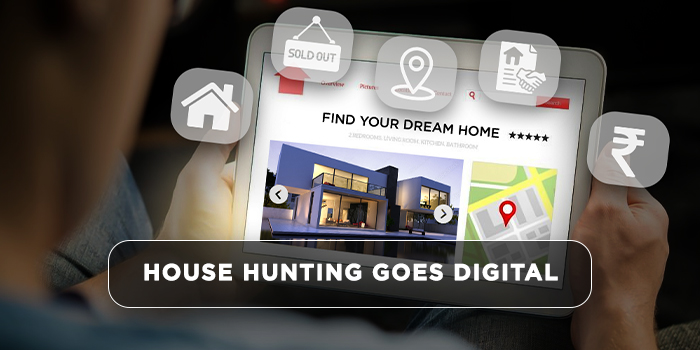
House hunting goes digital

Just as in other domains in our lives like paying taxes and buying groceries, the Internet is now playing a major role in our search for that dream home as well. House hunting has gone seriously digital as more and more people opt for online avenues to find their abode of choice, triggering a rising demand for digital portals that help consumers in their search and discovery, a trend that has only gathered momentum during the and post-pandemic.

This trend is attributed to the rising penetration of the Net across different societal strata, growing urbanization and an increasing willingness to adopt new technology, with the proliferation of smart phones and tablets. Also during the pandemic, particularly during the second wave when there was a slump in the real estate market, property tech entities saw the future and invested heavily in emerging tech like using drones for pictures and video walkthroughs of properties, besides using big data to aggregate a whole host of information that would help the home buyer make an informed choice and in double quick time.

The result? Instead of the pre-Covid 7-8 physical visits to the site, nowadays it’s often just 2 or 3 before the customers firm up their decisions. This is simply because they could garner all the relevant information besides get a complete visual sense of the property online before they even set foot on the site physically. The online slant towards house-hunting has also been seen in smaller cities and towns, since all developers and marketing agents are now totally focused on digital showcasing of properties.

With the Internet playing an increasingly critical role in the search for properties, traditional media tools for showcasing real estate products like print ads or newspaper advertorials are fast losing the dominance they always used to enjoy. While outdoor billboards are still in currency, most of the main campaigns have moved online, with increasing use of new platforms like social media content, Google ads, banner ads, search and discovery portals, online PR, email campaigns, etc. Even most of the transactions nowadays are conducted online using digital payment gateways and real-time transaction engines.

What are the obvious benefits of online house-hunting?

# Saves time: With people hard-pressed for time, hopping from one location to another in search of your ideal home can be hugely taxing and even impractical sometimes. Thanks to the property portals and listings, you can explore a large number of properties in a timely fashion.

# Wider umbrella: Sitting on your laptop/PC, the world is your oyster as you can search for properties anywhere in the city or in other cities as well. This gives you a wider umbrella of products to choose from.

# You are in control: Since you are in control of the search yourself, you can narrow down the search effort suited to your preferred parameters.

# Real-time updates: A very important advantage of online property search is that details and listings are updated in real time and you don’t waste your time on some product that’s no more on the table.

# Better credibility: An online presence or profile will always add more credibility to the developer or the selling party. For instance, if a rental property is listed online, it evokes more trust among the home-seeker.

# You get much more: An online search doesn’t only give you the option to buy or sell or rent, but gives you access to a whole host of allied services like vaastu consultants, valuation and renovation services, legal, interiors, architectural and structural inputs, etc.

# It’s more effective: An online presence gives you much more exposure and a larger basket of options, whether you are a buyer, seller or tenant.

# Filtering tools: When checking listings online, you have the option to choose from an array of filtering tools to whittle down the scope of your search in terms of preferred location, price band, floor area, features, etc. You can even create a folder comprising your preferred properties that showed up in the search.

Disclaimer : Information contained and transmitted by us are for information purposes only. All views and/or recommendations are those of the concerned author personally and made purely for information purposes. Nothing contained in the articles should be construed as business, legal, tax, accounting, investment or other advice or as an advertisement or promotion of any project or developer or locality. Pioneer Property Management Ltd. does not offer any such advice. No warranties, guarantees, promises and/or representations of any kind, express or implied, are given as to (a) the nature, standard, quality, reliability, accuracy or otherwise of the information and views provided in (and other contents of) the articles or (b) the suitability, applicability or otherwise of such information, views, or other contents for any person’s circumstances. We shall not be liable nor shall be held responsible in any manner for any action taken based on the published information (whether in law, contract, tort, by negligence, products liability or otherwise) for any losses, injury or damage (whether direct or indirect, special, incidental or consequential) suffered by such person as a result of anyone applying the information (or any other contents) in these articles or making any investment decision on the basis of such information (or any such contents), or otherwise. The users should exercise due caution and/or seek independent advice before they make any decision or take any action on the basis of such information or other contents.