

admin, Author at Pioneer Property - Page 6 of 14

The concept of Cooperative Housing Societies

A housing cooperative is a membership-based legally registered cooperative or corporation owning real estate comprising one or multiple residential buildings. Based on the core values of self-help, self-responsibility, democracy, equality, equity and solidarity, such societies operate under the auspices of the cooperative legal framework existing at the regional or national level.

One can become a member of such a housing cooperative by buying shares which entitles him to occupying a dwelling unit in the society, an apartment or a bungalow/row house, depending on the format. The spirit of the cooperative society model is an amalgam of voluntary management, shared expenses and community living.

Advantages of living in a cooperative housing society:

# Affordable: Properties in such societies are more affordable than standalone units.

# A fair deal: Since profit-making is not at the core of this model, you usually get a fair deal.

# Safe and secure: Gaining membership into such cooperative housing societies involves painstaking due diligence and hence, unwanted elements are automatically weeded out.

# A tax asset: You are able to deduct your share of property tax/mortgage paid by the society, resulting in substantial tax savings.

# Have a say: Your voice counts in every single decision taken during the creation of the housing cooperative, from design and planning to maintenance charges, etc.

# No meddling: As a member of the society, you don’t face any intervention from the outside and can keep enjoying the security and benefits that come with the membership.

# Community living: You enjoy the benefits and pleasures of community living with an inbuilt social fabric and the bonhomie and support that come with it.

# Efficient maintenance: Aspects of upkeep and preventive maintenance as well as specific owner needs are efficiently met through the cooperative model of voluntary management.

# Reliable: Thanks to the unique legal locus standi of the society, this is a safe and reliable format and has the resilience to sustain itself, making it a great investment as well as dwelling option.

Key principles of a housing society: # Membership is open to all individuals sharing common interests.

# It is a voluntary organization working under the concept of self-help and self-reliance.

# Office-bearers are democratically chosen.

# Legal entities registered under the Cooperative Societies Act.

# Equal contribution in all affairs of the society, from maintenance to capital expenditure.

# Training for members on the benefits of community living and legal compliance.

# A housing society is a welfare model with all members having each other’s backs.

Objectives of housing societies

# Basic necessities like water and power are provided to members.

# The member doesn’t have to worry about maintenance of the property.

# Members can avail loans from the cooperative society for house-building or renovation/expansion.

# The society acquires land, builds the dwelling units and distributes those among members.

# Through mutual cooperation, a healthy-living ecosystem is created.

Disclaimer : Information contained and transmitted by us are for information purposes only. All views and/or recommendations are those of the concerned author personally and made purely for information purposes. Nothing contained in the articles should be construed as business, legal, tax, accounting, investment or other advice or as an advertisement or promotion of any project or developer or locality. Pioneer Property Management Ltd. does not offer any such advice. No warranties, guarantees, promises and/or representations of any kind, express or implied, are given as to (a) the nature, standard, quality, reliability, accuracy or otherwise of the information and views provided in (and other contents of) the articles or (b) the suitability, applicability or otherwise of such information, views, or other contents for any person’s circumstances. We shall not be liable nor shall be held responsible in any manner for any action taken based on the published information (whether in law, contract, tort, by negligence, products liability or otherwise) for any losses, injury or damage (whether direct or indirect, special, incidental or consequential) suffered by such person as a result of anyone applying the information (or any other contents) in these articles or making any investment decision on the basis of such information (or any such contents), or otherwise. The users should exercise due caution and/or seek independent advice before they make any decision or take any action on the basis of such information or other contents.

What are IGBC-certified green buildings?

A built structure earns the moniker of a “green building” when it puts the natural environment at the heart of its form and function. This is done by using sustainable materials in construction and optimization of natural resources like water, light and air to improve energy efficiency and ensure better ventilation. Such buildings produce less non-biodegradable waste and offers healthier indoor air quality to occupants.

The pandemic which turned our world upside down, has had one positive impact on our lives, though. It has brought us back in touch with Nature, leading to a renewed interest and traction for green buildings, as more and more people are now concerned about the ecological footprints their residences or offices are leaving on the environment.

The Indian Green Building Council (IGBC) was created in 2001 as an outfit of the Confederation of Indian Industry (CII) with the vision of enabling “a sustainable built environment for all and help India become a global leader in sustainable built environment by 2025”. IGBC Green Homes is the first rating programme developed in India exclusively for the residential sector.

The consensus-based rating system was formulated keeping in mind tech inputs and raw materials that can be easily sourced in today’s market scenario, with the objective of promoting the use of local resources for design and construction, energy efficiency, water conservation, reduced use of fossil fuels and responsible handling of domestic waste to protect the environment.

The system is both prescription- and performance-based, appraising mandatory requirements as well as credit points and is designed to be user-friendly. The primary concern is the quality of life that occupants can expect, assessed based on national as well as global parameters.

Benefits of IGBC Green New Buildings certification

The benefits of Green New Buildings certified by IGBC are numerous, whether tangible or intangible. The tangible benefits for occupants would primarily include a significant reduction in power and water consumption. While water use could be cut down by 30 to 50 per cent, a 20 to 30 per cent reduction in energy spending could be achieved in the best-case scenario.

The intangible advantages are no less critical and would include superior indoor air quality, lots of natural light filtering in, leading to significant health and well-being benefits for occupants, and of course safeguarding natural resources which are finite, besides more efficient handling of waste. All these pluses automatically result in enhanced resale value of the property.

Categories addressed by the IGBC rating system include:

# Site selection & planning
# Water conservation
# Energy efficiency
# Materials & resources
# Indoor air quality
# Innovation & design process

Scope of IGBC rating system

The IGBC Green Homes Rating System evaluates new residential buildings and major renovation work in existing ones, for both individual units and multi-dwelling residential units. These would include gated communities, residential high-rises, hostels, serviced apartments, resorts, guest houses, etc.

The green building movement in the Indian real estate industry is set to reach an inflection point with the country expected to do more to reduce its carbon footprint by using more sustainable materials in construction. With India now accounting for 10 to 12 per cent of global space for green structures, the confidence in the movement is growing every day as more and more developers jump onto the green building bandwagon.

Disclaimer : Information contained and transmitted by us are for information purposes only. All views and/or recommendations are those of the concerned author personally and made purely for information purposes. Nothing contained in the articles should be construed as business, legal, tax, accounting, investment or other advice or as an advertisement or promotion of any project or developer or locality. Pioneer Property Management Ltd. does not offer any such advice. No warranties, guarantees, promises and/or representations of any kind, express or implied, are given as to (a) the nature, standard, quality, reliability, accuracy or otherwise of the information and views provided in (and other contents of) the articles or (b) the suitability, applicability or otherwise of such information, views, or other contents for any person’s circumstances. We shall not be liable nor shall be held responsible in any manner for any action taken based on the published information (whether in law, contract, tort, by negligence, products liability or otherwise) for any losses, injury or damage (whether direct or indirect, special, incidental or consequential) suffered by such person as a result of anyone applying the information (or any other contents) in these articles or making any investment decision on the basis of such information (or any such contents), or otherwise. The users should exercise due caution and/or seek independent advice before they make any decision or take any action on the basis of such information or other contents.

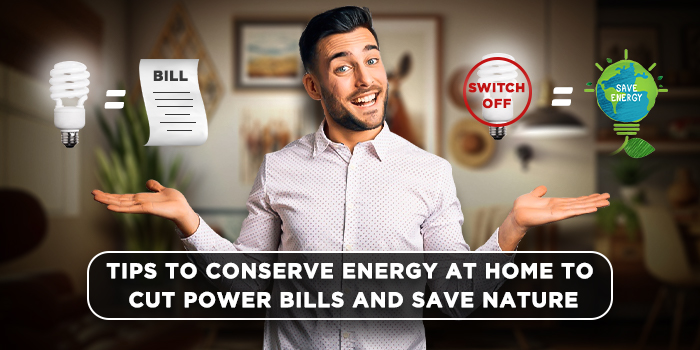
Tips to conserve energy at home to cut power bills and save nature

Conserving energy at home is the habit of using less power to lower energy bills, which in turn reduces the environmental impact of producing and consuming energy. While it entails dialing down on the use of electricity and gas, it’s also about simple day-to-day habits like turning off the lights and fans when you step out of a room, or appliances when not in use.

You can also try performing some manual household chores like hang-drying clothes instead of putting those in the dryer, using your hands to wash dishes and not putting them in the dishwasher, etc. These small habits in everyday life can go a long way in not only lessening your power bill load, but also contribute significantly towards protecting the environment. After all, there are only finite reserves of energy on our planet and when we consume energy responsibly at home, we are doing a world of good to our planet as well.

Here are some simple tips to save energy at home:

# Switch off: A good place to start in curbing domestic energy consumption is to inculcate the habit of switching off all lights and fans while leaving a room. It’s a simple daily practice that can result in substantial savings in your energy bills if followed religiously

# Change your lightbulbs: Switch to LED (light-emitting diode) bulbs which consume at least 25% less electricity and last up to 10 times longer than traditional incandescent lightbulbs. What’s more, these lights are stylish and much more affordable.

# Use energy-efficient appliances: Opting for smarter, more energy-efficient home appliances can help cut energy usage by 50%. This is all the more applicable for refrigerators and dryers, which are extremely energy-intensive consumer durables. Also, energy-efficiency of appliances wane with age. So, make sure you do proper preventive maintenance and replace those when necessary.

# Unplug your devices: Make sure to switch off all your devices when not in use. Even when you keep your devices on standby mode, they consume power. So, it’s best to unplug your TV or DVD player while idle. Smart automated devices can detect when the device is not in use and turn off the power supply

# Use instant water heaters: Switching to instant water heaters can help save up to 25% of your energy bill compared to when you use storage heaters. Every time you don’t use the water you heat and store in the tank, it gets cold and must be heated all over again. This results in needless power bills. Instant heaters, on the other hand, provide water on demand and don’t need a storage tank. Hence, there’s no standby energy loss

# Cut down on water usage: If you work consciously towards it, you can reduce domestic water consumption substantially. For instance, take quick showers and turn off faucets when not in use, even for a few seconds when doable. Also, use only the amount of water you need during cooking. It helps to reduce water consumption if you keep the lid on while cooking

# Insulate your home properly: When you take care to insulate your home well, it’s a lot easier to keep the inside cool or heated, whatever the need of the season. Using double-glazed glass on windows and making sure that the doors and windows are shut properly when the air-conditioners are in use helps save energy and lower your bills.

# Use solar-powered devices: There are a clutch of solar-powered home appliances and electronic products available in the market these days which can help in not only cutting power bills but protecting the environment as well. Also, solar-powered electronic devices are easier and cheaper to maintain

Disclaimer : Information contained and transmitted by us are for information purposes only. All views and/or recommendations are those of the concerned author personally and made purely for information purposes. Nothing contained in the articles should be construed as business, legal, tax, accounting, investment or other advice or as an advertisement or promotion of any project or developer or locality. Pioneer Property Management Ltd. does not offer any such advice. No warranties, guarantees, promises and/or representations of any kind, express or implied, are given as to (a) the nature, standard, quality, reliability, accuracy or otherwise of the information and views provided in (and other contents of) the articles or (b) the suitability, applicability or otherwise of such information, views, or other contents for any person’s circumstances. We shall not be liable nor shall be held responsible in any manner for any action taken based on the published information (whether in law, contract, tort, by negligence, products liability or otherwise) for any losses, injury or damage (whether direct or indirect, special, incidental or consequential) suffered by such person as a result of anyone applying the information (or any other contents) in these articles or making any investment decision on the basis of such information (or any such contents), or otherwise. The users should exercise due caution and/or seek independent advice before they make any decision or take any action on the basis of such information or other contents.
Evolution of CRE towards hybrid model

In planning workspace infrastructure, it’s the time to reboot, use our learnings from the pandemic, keeping in mind the needs of today’s employees and the mandate for sustainable growth. While achieving corporate goals will always remain the fulcrum of strategy, it’s important to factor in the fresh challenges and ensure that staff members are happy.

The acute uncertainty that gripped the world over the past three years has forced all organizations to rethink their commercial real estate strategy to cut capital expenditure and ensure they stay afloat. While there’s no one-size-fits all plan, the new overwhelming favourite infrastructure mould is a combination of physical and virtual workspaces to meet the demands of the hybrid work model.

Today’s offices are designed to offer the flexibility to scale up or down with the minimum of fuss, while making room for emerging work cultures and elastic timings. Without optimizing a hybrid commercial real estate (CRE) strategy, companies can’t optimize the hybrid work model. Even before Covid-19 struck, there was a clear slant towards remote and hybrid work mode. The pandemic simply turbo-charged the trend, and clearly, this is the new normal.

However, at the end of the day, the shift towards a hybrid CRE model has to support the bottom line, and to ensure that, a robust workplace data analytics system must be put in place that would shape the flexi office strategy. Tomorrow’s workplaces will be defined by key factors like agility, flexibility, equity and productivity.

Let us look at key factors that make up an efficient hybrid workspace:

# Flexibility: Being nimble in planning office infrastructure is the currency of today, whether it is working out logistics or strategizing business. It’s important to offer a flexi workspace to the employees so that work can be fun while productivity gets boosted. More open and minimalistic workstations can promote better intra-office communication and ideas sharing. This enables the management to get the best out of its collective human resources capital. When your employees are happy and talking to each other, you get better output. That’s a given. So, think re-engineering of workspaces, think hybrid CRE to cater to today’s ever-morphing requirements.

# Efficiency: As we come out of the morass inflicted by the pandemic, companies are scampering to make up for lost time. While aiming for higher productivity and accelerating recovery, most organizations are opting for a hybrid work model where employees can choose how and from where they would like to work for best results. The combination of physical and virtual workspace facilities makes business collaborations location-agnostic. This saves substantial cost and time in commuting, while offering the workforce the freedom to choose their comfort zone and work out the right balance in workspace environment.

# Uniformity: While equipping employees to work from various locations, it is critical to ensure uniformity in the core culture and identity of the organization, the amenities extended and workspace ergonomics. The dynamics of the hybrid work model can work perfectly and to everybody’s benefit only when instilled with the core values and ethics of the company and organizational synergy across all locations.

# Location-agnostic: The vastness of India’s sheer geographical size was never really leveraged before the pandemic when corporates fished for talent. The search was always skewed by the candidate’s location or willingness to relocate. Now, that large pond of human resources has become easy to reach and harness. The hybrid work model and concomitant CRE infrastructure has enabled companies to hire talent from anywhere, even smaller cities, and equip them with the benchmarked work environment and amenities to function with elan from their location of choice. Such a flexible work model has been a genuine game-changer. Being location-agnostic is enabling companies to retain manpower, while boosting productivity at the same time.

Disclaimer : Information contained and transmitted by us are for information purposes only. All views and/or recommendations are those of the concerned author personally and made purely for information purposes. Nothing contained in the articles should be construed as business, legal, tax, accounting, investment or other advice or as an advertisement or promotion of any project or developer or locality. Pioneer Property Management Ltd. does not offer any such advice. No warranties, guarantees, promises and/or representations of any kind, express or implied, are given as to (a) the nature, standard, quality, reliability, accuracy or otherwise of the information and views provided in (and other contents of) the articles or (b) the suitability, applicability or otherwise of such information, views, or other contents for any person’s circumstances. We shall not be liable nor shall be held responsible in any manner for any action taken based on the published information (whether in law, contract, tort, by negligence, products liability or otherwise) for any losses, injury or damage (whether direct or indirect, special, incidental or consequential) suffered by such person as a result of anyone applying the information (or any other contents) in these articles or making any investment decision on the basis of such information (or any such contents), or otherwise. The users should exercise due caution and/or seek independent advice before they make any decision or take any action on the basis of such information or other contents.

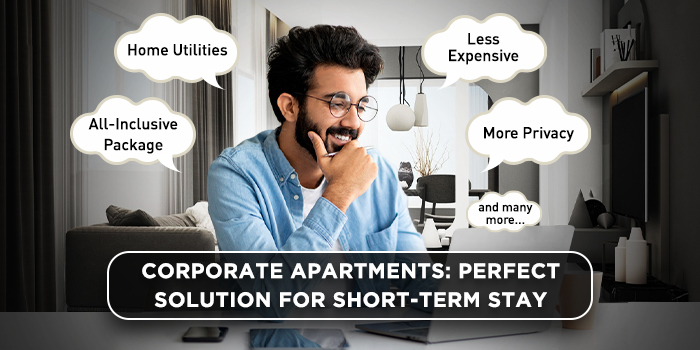
Corporate apartments: Perfect solution for short-term stay

Corporate housing is a short-term rental model targeted primarily at the business traveller or any person looking for an extended-stay full-service accommodation. Needless to say, in the post-pandemic world of hybrid work mode, many medium and large corporate entities are looking for such apartments which they can rotate among their travelling executives.

Even for freelance professionals looking for an extended-stay option as an alternative to hotel accommodation or for those relocating to a new city, such short-term hospitality models, also known as “serviced apartments” or “extended-stay apartments”, are attractive solutions. For the latter group, this allows them the leeway to settle in a bit before they can plan moving into a more permanent accommodation once they know the city better. Sometimes, such accommodation is also perfect for medical stays when you want to be close to the hospital your loved one is in.

As opposed to a hotel room, a corporate apartment is not just a bed and bathroom. It’s a fully furnished unit usually offering a clutch of amenities like a fully-equipped kitchen, TV set, coffee-maker, dishwasher, refrigerator, cleaning services, etc, besides of course a reliable wi-fi connectivity – all included in the rental tariff. In other words, one can actually live off a suitcase, while enjoying a “home away from home” feel.

While a majority of clients would typically stay for a couple of weeks or on the outside, a month perhaps, the rent-out policy for corporate apartments is usually quite flexible, with tenants sometimes opting to stay for even months together. In case of unusually long stays, sometimes a monthly rental arrangement is also worked out.

What are the obvious benefits of staying in a corporate apartment?

# Less expensive: Corporate apartments usually work out less expensive than hotel stay, while you still feel at home.

# More privacy: This arrangement gives you much more privacy than a hotel room since you don’t normally have a fleet of cars parked outside, deal with a constant flow of temporary guests, or have to go out for every meal, since you would have a fully-functional kitchen.

# Less noise: Corporate apartment properties are usually located in quieter residential areas instead of bang in the heart of the commercial district, hence more peaceful.

# Bonus features: Sometimes, if you are lucky, you could have access to an in-house gym, indoor sports or swimming pool.

# Home utilities: Corporate housing will normally come with gadgets and appliances like TV set with cable/DTH, refrigerator, dishwasher, iron, washer-dryer, coffee maker, microwave oven and the like.

# Connected 24×7: All such apartments come with a highly reliable broadband wi-fi service built into the package so that be it work or entertainment, you are always connected, never missing a beat.

# Less paperwork: Moving into a fully-serviced corporate apartment usually entails very little paperwork and minimum waiting period unlike entering into a proper lease rental agreement for a conventional rented place. Just take your keys and start living with everything cared for. It’s a convenient and pragmatic solution for short-term stays.

# All-inclusive package: In a full-service corporate apartment, the package normally includes all utilities including water, electricity, cooking gas, etc. To sum up, corporate apartments constitute both a product and a service. While the apartment itself is the product, all the allied facilities that come with the accommodation can be referred to as the service package.

Disclaimer : Information contained and transmitted by us are for information purposes only. All views and/or recommendations are those of the concerned author personally and made purely for information purposes. Nothing contained in the articles should be construed as business, legal, tax, accounting, investment or other advice or as an advertisement or promotion of any project or developer or locality. Pioneer Property Management Ltd. does not offer any such advice. No warranties, guarantees, promises and/or representations of any kind, express or implied, are given as to (a) the nature, standard, quality, reliability, accuracy or otherwise of the information and views provided in (and other contents of) the articles or (b) the suitability, applicability or otherwise of such information, views, or other contents for any person’s circumstances. We shall not be liable nor shall be held responsible in any manner for any action taken based on the published information (whether in law, contract, tort, by negligence, products liability or otherwise) for any losses, injury or damage (whether direct or indirect, special, incidental or consequential) suffered by such person as a result of anyone applying the information (or any other contents) in these articles or making any investment decision on the basis of such information (or any such contents), or otherwise. The users should exercise due caution and/or seek independent advice before they make any decision or take any action on the basis of such information or other contents.

Best gifting ideas for housewarming

Moving house is always a massive milestone worth celebrating, whether you are relocating to your dream apartment or a new rental place. The joyous occasion of housewarming is made even more memorable by friends and family who gather to shower you with their best wishes and share your special moment with you.

If you are on this invitee list, you must choose your housewarming gift with care and thought, keeping in mind the lifestyle and taste of the hosts, the spatial pattern and look and feel of the new home and last but not the least, your budget for the spend. There are a plethora of gifting options to choose from. You only need to apply your mind to the task to find the right one for the hosts.

Here are some gifting ideas while going to a housewarming party:

# Home appliances: In today’s breakneck lifestyle, most families are striving to cut manual labour in completing daily chores so that they can manage their time better. In this scenario, you can scarcely go wrong with home appliances as gift ideas to celebrate housewarming. Contraptions like air-fryers, juicer-blenders, coffee-makers, vacuum cleaners, electric kettles, etc., can be extremely useful and welcome solutions.

# Bluetooth speakers: Portable Bluetooth speakers are a wonderful gifting idea for lovers of music, since they can carry their favourite tunes around the house with them, from the living room to the kitchen and even to the bathroom. These speakers are now easily available in a variety of sizes and price points.

# Reusable flower jars: A bouquet of colourful flowers in a pretty, reusable glass jar is a great gift idea, since the elegant flower pot can be subsequently used for indoor plants or simply as part of the overall home décor.

# Reading lights: So many of us and our friends love to read and often stay up late to indulge our passion. For people like them, study lights can constitute a dear-to-heart housewarming gift. Nothing too extravagant or fancy, just warm and functional and personal.

# Fitness equipment: If your hosts are extremely fitness conscious, you could check with them what else they can do with and figure out a suitable gift. This might be one of those new AI-based fitness apps, a stationary bike or ab-crunchers. Don’t forget to check space available and what they already have.

# Wall décor: Tastefully coordinated wall décor accents like stickers, posters, hangings, shelves, framed paintings, etc. have the power of brightening up the entire house and draping everything with a happy vibe. Do keep in mind the colour scheme used for the house and also the style and personality of the new home owner/tenant.

# Lifestyle gift ideas: For hosts who are inherently stylish and flamboyant, you can choose from a clutch of lifestyle gift ideas like an LED liquor shelf, garden sprinklers, wall-mounted speakers, aroma diffusers, smart indoor planters, exotic potpourri, bean bags, scented candles, etc.

# Cozy gift ideas for close friends: For that best buddy or favourite cousin setting up a new home, often, quirky and fun gift ideas can work best. You can relive the good times you have had together by choosing from stuff like throw cushions, wall or hobby art, memorabilia, cheese board or a personalized rug. Champagne and wine or bespoke wine glasses also work well for close friends who are social drinkers. Or, for that matter, a mulled wine cocktail kit, complete with infusion bags and recipe guide.

Disclaimer : Information contained and transmitted by us are for information purposes only. All views and/or recommendations are those of the concerned author personally and made purely for information purposes. Nothing contained in the articles should be construed as business, legal, tax, accounting, investment or other advice or as an advertisement or promotion of any project or developer or locality. Pioneer Property Management Ltd. does not offer any such advice. No warranties, guarantees, promises and/or representations of any kind, express or implied, are given as to (a) the nature, standard, quality, reliability, accuracy or otherwise of the information and views provided in (and other contents of) the articles or (b) the suitability, applicability or otherwise of such information, views, or other contents for any person’s circumstances. We shall not be liable nor shall be held responsible in any manner for any action taken based on the published information (whether in law, contract, tort, by negligence, products liability or otherwise) for any losses, injury or damage (whether direct or indirect, special, incidental or consequential) suffered by such person as a result of anyone applying the information (or any other contents) in these articles or making any investment decision on the basis of such information (or any such contents), or otherwise. The users should exercise due caution and/or seek independent advice before they make any decision or take any action on the basis of such information or other contents.

The right flooring option for your home

When doing the interiors of our home, we often think about the shade of paint on the walls, the furniture in different rooms, the light fittings and the bathroom ware. We sometimes tend to forget the flooring in the bargain. However, the importance of choosing the right flooring for your new home can’t be overemphasized. Doing your research right and finding out about the options available can help you choose the right flooring material and remain worry-free for years.

It’s not just about aesthetics, rather, more about function. So, the nature of the space and its usage will both come into play. That means you might need different flooring solutions for the different rooms in your home. It also depends on the climate in your location, your lifestyle, the size and shape of the room and of course, your budget.

The look and feel of your floor will influence a whole lot of things that make up your interiors, including light fittings and wall shades, not to mention furniture. The flooring must be in sync with the overall design and spatial use of the area being covered, while ensuring visual appeal and longevity. So, choose your floor well.

What are the different flooring options you can choose from?

# Marble: Areas of your home which don’t experience high foot traffic are suitable for marble flooring. It exudes a sense of class and also can last long, but must be used in the right spaces.

# Vitrified tiles: Vitrified tiles are a favoured flooring option for many homes and are made by adding silica and clay to the mix of ceramic tiles. Albeit somewhat more expensive than ceramic tiles, these are easily procured and easily laid. Besides, you can choose from a plethora of colour and pattern options for a really attractive flooring solution and a great alternative to granite or marble.

# Vinyl: If you have pets in the house, vinyl can be a great flooring option. It provides soft cushioning which can ensure traction for their limbs and help protect their joints. It also resembles wood in appearance and exudes the same sense of warmth as hardwood. Yet another plus working in favour of vinyl is that it’s a wonderful sound absorber. So, you can cut out the reverbs on your favourite music.

# Wood: The biggest advantage of using hardwood for your flooring is that it’s neutral and goes well with any style of interior irrespective of the colour palette or the design language you choose. Also, because of its innate durability, hardwood can increase the resale value of your home substantially. A note of caution though. In very humid conditions, wood flooring could swell and deform if not sealed well. So please take utmost care at the installation stage.

# Laminate: Since laminates are tough and can withstand a lot of stress, these constitute a great flooring option for areas that receive high foot traffic. Besides, laminates are easy to maintain and relatively less expensive, not to mention their versatility.

# IPS: Indian patent stone is another inexpensive flooring alternative. Made of concrete mix, IPS has a more rustic and unpolished veneer and is extremely durable. You can keep stains away if you take care with using sealing solution or a coat of wax.

Disclaimer : Information contained and transmitted by us are for information purposes only. All views and/or recommendations are those of the concerned author personally and made purely for information purposes. Nothing contained in the articles should be construed as business, legal, tax, accounting, investment or other advice or as an advertisement or promotion of any project or developer or locality. Pioneer Property Management Ltd. does not offer any such advice. No warranties, guarantees, promises and/or representations of any kind, express or implied, are given as to (a) the nature, standard, quality, reliability, accuracy or otherwise of the information and views provided in (and other contents of) the articles or (b) the suitability, applicability or otherwise of such information, views, or other contents for any person’s circumstances. We shall not be liable nor shall be held responsible in any manner for any action taken based on the published information (whether in law, contract, tort, by negligence, products liability or otherwise) for any losses, injury or damage (whether direct or indirect, special, incidental or consequential) suffered by such person as a result of anyone applying the information (or any other contents) in these articles or making any investment decision on the basis of such information (or any such contents), or otherwise. The users should exercise due caution and/or seek independent advice before they make any decision or take any action on the basis of such information or other contents.

Importance of open space in a gated community

With the continuous migration of people from smaller towns to metro cities, and time an increasingly precious commodity, gated communities have been sprouting in big cities and its fringes. And why not? In today’s breakneck urban lifestyle, this seems to be the perfect solution, combining the pleasures of aesthetics and the benefits of functionality.

Real estate developers investing in this domain are providing a host of attractive add-ons like parks, children’s play areas, jogging and cycling trails, outdoor sports facilities, swimming pool, landscaped gardens, formatted meeting areas, yoga and meditation centre and a lot more.

The idea is to provide a whole gamut of options within the walls of the gated community itself so that residents don’t need to step out for many pursuits, while providing the tools and encouragement to stay fit as well as active and passive entertainment. However, the biggest plus that residents have come to value in these projects is the sense of bonding that tends to develop with your neighbours, thus fostering a community feeling that’s priceless.

Some of the advantages of open space in a gated community include:

# Better quality of life: The wide, open spaces ensure better ventilation, less pollution and noise and as a consequence, a more peaceful and better-quality life. You look forward to coming home after a grueling day at work as the greenery and peace and the inviting pool beckon. Once you are inside, you have all the accoutrements to spend real quality time with your family.

# Live healthy: The abundance of greenery and open space and access to sports like tennis and swimming and even open-air workout zones provide you and your family the right ingredients and motivation to stay fit and healthy. The peace and quiet can be surprisingly de-stressing after a hard week or a tough day and have a profoundly positive psychological impact on residents, improving their emotional and spiritual well-being.

# Secured ROI: The demand for gated residential projects has been steadily on the rise, even before Covid-19 struck. After the pandemic, it has only gathered momentum as most home-seekers these days prefer living in a large-format gated development rather than a standalone house so that they can avail of home-plus features like large open spaces, better security, a plethora of outdoor activities and the general peace and quiet. When this format is so coveted, a handsome return on your investment is obviously guaranteed.

# Bond better with neighbours: The large open spaces are designed to encourage social interaction. Residents tend to gather at common meeting areas, engaging in conversation that promotes camaraderie and friendship. This internal community becomes very important and precious in today’s rushed, volatile and unpredictable world where social interaction is otherwise diminishing and often neighbours aren’t even acquainted with one another.

# Bonus for kids, elderly: For growing children and the elderly residents, the open spaces in a complex are a boon. The kids can play and run around, thus getting valuable physical exercise while making friends and enjoying themselves thoroughly. This is critical for their physical and mental development and a bonus for their parents who don’t have to take them outside to pursue physical activities. Similarly, the aged residents can go on their routine of morning or evening walks in a serene and secure environment and interact with others of their age group that can help relieve stress and fight loneliness.

Disclaimer : Information contained and transmitted by us are for information purposes only. All views and/or recommendations are those of the concerned author personally and made purely for information purposes. Nothing contained in the articles should be construed as business, legal, tax, accounting, investment or other advice or as an advertisement or promotion of any project or developer or locality. Pioneer Property Management Ltd. does not offer any such advice. No warranties, guarantees, promises and/or representations of any kind, express or implied, are given as to (a) the nature, standard, quality, reliability, accuracy or otherwise of the information and views provided in (and other contents of) the articles or (b) the suitability, applicability or otherwise of such information, views, or other contents for any person’s circumstances. We shall not be liable nor shall be held responsible in any manner for any action taken based on the published information (whether in law, contract, tort, by negligence, products liability or otherwise) for any losses, injury or damage (whether direct or indirect, special, incidental or consequential) suffered by such person as a result of anyone applying the information (or any other contents) in these articles or making any investment decision on the basis of such information (or any such contents), or otherwise. The users should exercise due caution and/or seek independent advice before they make any decision or take any action on the basis of such information or other contents.

Emerging technologies in commercial real estate

The pandemic has turned the entire mode of business in commercial real estate on its head. Site visits, paperwork, bank cheques and handshakes are passe. Thanks to the penetration of cutting-edge technology, transactions in the commercial real estate domain today are enabled by contactless remote technology including virtual tours, paperless deals and the like, powered by artificial intelligence, with the aim of reducing human interaction and boosting efficiency.

In the light of such sweeping changes in the commercial real estate landscape, you can’t afford to lag behind in adopting smart tech. It’s no longer an option, it’s now a necessity.

So, what are the must-have tech tools you should invest in?

# Virtual tours and CRM: One of the biggest disruptions in the real estate industry in recent years has been the use of virtual 3-D tours of properties, a technology further perfected during the pandemic. This is an absolute must-have in today’s context with customers less mobile and hamstrung in many other ways. Such virtual visits must be supported by a sophisticated customer relationship management (CRM) system through which you can guide the prospective customer through the entire process by using chat and email, answering each and every query along the way to close the loop efficiently.

# Digital storage, automation: The era of mountains of paper files and folders is gone. Documents must be digitally stored these days and you need to invest in that mechanism. Also, the entire ecosystem of payments and invoicing and rent collection, etc must be automated so that keeping track of changes and increments becomes a lot easier and you deploy a lot less manpower in those areas. The investment you make in such automation is worth every penny as you will recover the cost in double quick time.

# AI or Artificial Intelligence: Today, commercial real estate owners can make use of AI tools to take care of the entire property management infrastructure which would span security to monitoring to temperature control to running repairs and routine maintenance. This AI comfort saves both time and manpower, which you can gainfully redirect towards handling the sales pipeline and boost lead conversion.

# Building Information Modelling (BIM) software: This is a relatively new tool that enables the entire team of developers, architects, engineers, investors, etc to work in tandem through the planning, designing and execution process of the property using 3D models. So, instead of the old-fashioned blueprints of designs and drawings, BIM can provide a detailed 3D imagery of the project, giving both developer and buyer a clearer picture at the press of a key.

# Tenant management portals: Transparency is the buzzword in today’s real estate industry and since the commercial real estate segment is dominated by lease rentals, tenants are always looking for the assurance of transparency from their landlords. By using these portals to manage lease renewal or amendment, easy access to lease documents, maintenance requests, rent collection, etc, you can ensure transparency is at the core of your business philosophy. It also substantially cuts down on the time and bandwidth you spend on calls and emails.

# Automation in social media advertising: Using social media advertising automation, commercial real estate developers can generate new campaigns automatically through hi-tech software systems and market those campaigns to a targeted audience for optimum results. Such ad automation allows realtors to access real-time data analytics like demographics, views, clicks, etc, and thus fine-tune marketing strategy as they go along. With fast-changing algorithms used by search engines, it has become more pertinent to harp on market leadership and boost brand awareness. It helps when your social media ad systems are automated to reach the right audience every time.

Recommendation:

Project of the week – Amantran, 129 limited edition row bungalows, located next to Joka Metro

Disclaimer : Information contained and transmitted by us are for information purposes only. All views and/or recommendations are those of the concerned author personally and made purely for information purposes. Nothing contained in the articles should be construed as business, legal, tax, accounting, investment or other advice or as an advertisement or promotion of any project or developer or locality. Pioneer Property Management Ltd. does not offer any such advice. No warranties, guarantees, promises and/or representations of any kind, express or implied, are given as to (a) the nature, standard, quality, reliability, accuracy or otherwise of the information and views provided in (and other contents of) the articles or (b) the suitability, applicability or otherwise of such information, views, or other contents for any person’s circumstances. We shall not be liable nor shall be held responsible in any manner for any action taken based on the published information (whether in law, contract, tort, by negligence, products liability or otherwise) for any losses, injury or damage (whether direct or indirect, special, incidental or consequential) suffered by such person as a result of anyone applying the information (or any other contents) in these articles or making any investment decision on the basis of such information (or any such contents), or otherwise. The users should exercise due caution and/or seek independent advice before they make any decision or take any action on the basis of such information or other contents.

Boost your retirement plan with real estate investment

It’s a very common apprehension. As our work-life draws to a close, we are all concerned about whether we have socked away enough to support us in our retired life. A sum which might seem adequate today, could appear insufficient tomorrow as inflation continues to erode the net value of our savings. Investing for retirement can be particularly vexing since you would want your investment to be relatively risk-free and able to keep pace with inflation.

A great way to boost your nest egg is to invest in real estate, even if you have a portfolio of stocks and bonds. Real estate is less volatile compared to other asset categories and almost always outperforms other instruments of investment.

Investing in a property or buying your own home to open up a rental income avenue or investing in trusts can all have an additive effect on your savings portfolio, while reducing taxes and costs. This is a steady retirement income option that ebbs and flows with the prevailing inflation rate, giving you that shield of protection in your golden years.

So, what are the different avenues of letting real estate boost your retirement?

# Direct ownership of your home: When you own your own home, it’s an automatic long-term asset and provides you with the built-in buffer in the form of home equity that can be leveraged if required, to generate retirement income or as a safeguard against unforeseen risks and adverse events.

# Real Estate Investment Trusts or REITS: REITS are a kind of equivalent of mutual funds. Here, instead of a basket of company stocks, investment is in a collection of properties. The dividends are usually quite high, which means a neat retirement income minus the hassles of buying or managing a property. Also, by investing in multiple properties, you can hedge your bets.

# Rental income: Buying a property and renting it out also provides you with an avenue of steady monthly income, more so when the location is right. It is usually a more stable investment than in stocks and can even pay for your house loan and other maintenance costs. Also, it’s a permanent asset and will keep appreciating in value with time.

# Buy, improve, re-sell: If you plan and start well ahead of your superannuation, you can carefully choose and invest in a property at its launch stage, spend on some home improvement and embellishment and then re-sell at a neat profit when the time is right. You need to give yourself some time in hand and pick a winning location for this ploy to work. However, plenty of people are reaping lucrative ROI on their real estate assets all the time.

# Tax benefits: Since the government supports your investment with tax breaks, real estate is a great way to make your nest egg grow. From rental properties to empty land parcels to commercial buildings, there is a substantial tax benefit in every segment of real estate, like capital gains tax, deductions, depreciation, etc.

It’s always wise to have some extra stashed away for the golden years. Even your best-laid plans can sometimes go haywire for any number of reasons, not the least unforeseen medical expenditure. The best way to ensure a steady income stream post-retirement is to make a planned investment in real estate well in time.

Disclaimer : Information contained and transmitted by us are for information purposes only. All views and/or recommendations are those of the concerned author personally and made purely for information purposes. Nothing contained in the articles should be construed as business, legal, tax, accounting, investment or other advice or as an advertisement or promotion of any project or developer or locality. Pioneer Property Management Ltd. does not offer any such advice. No warranties, guarantees, promises and/or representations of any kind, express or implied, are given as to (a) the nature, standard, quality, reliability, accuracy or otherwise of the information and views provided in (and other contents of) the articles or (b) the suitability, applicability or otherwise of such information, views, or other contents for any person’s circumstances. We shall not be liable nor shall be held responsible in any manner for any action taken based on the published information (whether in law, contract, tort, by negligence, products liability or otherwise) for any losses, injury or damage (whether direct or indirect, special, incidental or consequential) suffered by such person as a result of anyone applying the information (or any other contents) in these articles or making any investment decision on the basis of such information (or any such contents), or otherwise. The users should exercise due caution and/or seek independent advice before they make any decision or take any action on the basis of such information or other contents.