

admin, Author at Pioneer Property - Page 4 of 14

Advantages of owning an office space in modern IT parks

Modern offices are not just about cubicles, workstations and washrooms. The way people work has been undergoing a sea change, more so during and after the pandemic, and contemporary office spaces are also being redefined to suit the demands of today’s employees. To retain your best human resources and to prosper as a company at the same time, there’s no better place than being located at a cutting-edge modern IT park. The three underlying themes that define today’s ideal workplace are collaboration, creativity and productivity. IT parks offer a vast array of services and facilities to companies, thus allowing them to carry out operations smoothly and maximize business potential. Such tech parks enjoy strong connections with the industry, offering office spaces with superior infrastructure on long-term lease or rental basis.

Incorporating latest technology and a host of new-age features like open floor plans, ergonomic furniture, intelligent illumination system maximizing natural light, soundproofing to lower noise levels, leafy corners, seamless video conferencing, etc., these modern offices are designed to boost efficiency and productivity by improving flexibility and a healthier ambience.

What are the benefits of owning an office in a tech park?

# Safety & security: Tech parks have well-organized and cutting-edge contemporary security systems so that you can go about your business worry-free. The safety and security of all your employees is a built-in guarantee that usually comes with the lease/rental agreement.

# Comfortable workspaces: Modern offices housed in large IT parks are designed for comfort and convenience, with features like ergonomic furniture, natural light, plenty of open, green spaces, etc. These design elements combine to cut stress and keep the employees happy and motivated. This translates into higher efficiency and productivity.

# Scale up seamlessly: When you wish to expand your business and scale up operations, you don’t have to look elsewhere. There’s usually ample space available within the same tech park perimeter for you to embark on your expansion project, with all the attendant amenities.

# Networking scope: Modern IT parks offer a wonderful platform for networking and open up ample collaboration opportunities. With a readymade stage for interaction with other businesses, you often get breakthrough ideas that could be profitably co-opted.

# Boost brand awareness: Having your office address in a prestigious IT park gives your brand greater credibility and helps promote awareness. Other businesses housed within the same tech park often tend to drive new customers through your door.

# Increase client confidence: Being located inside a modern tech park gives you a built-in advantage of better client perception and confidence in your brand. It sends out a message that you are thoroughly professional in your approach, well-organized and totally committed to service excellence.

# Hassle-free maintenance: Since the common facility management arm/agency of the tech park takes care of your office maintenance, your bandwidth can be totally devoted to growing your business.

# Parking no issue: One of the many reasons why you would like to be located inside a large-format tech park is the automatic advantage of ample parking space for your employees as well as customers.

# Creative corners: Innovative office design in modern IT parks also factors in the need for creative spaces where colleagues can congregate, brainstorm and collaborate on shared ideas. This is a great feature of such offices since it promotes problem-solving skills and a can-do mindset.

Disclaimer : Information contained and transmitted by us are for information purposes only. All views and/or recommendations are those of the concerned author personally and made purely for information purposes. Nothing contained in the articles should be construed as business, legal, tax, accounting, investment or other advice or as an advertisement or promotion of any project or developer or locality. Pioneer Property Management Ltd. does not offer any such advice. No warranties, guarantees, promises and/or representations of any kind, express or implied, are given as to (a) the nature, standard, quality, reliability, accuracy or otherwise of the information and views provided in (and other contents of) the articles or (b) the suitability, applicability or otherwise of such information, views, or other contents for any person’s circumstances. We shall not be liable nor shall be held responsible in any manner for any action taken based on the published information (whether in law, contract, tort, by negligence, products liability or otherwise) for any losses, injury or damage (whether direct or indirect, special, incidental or consequential) suffered by such person as a result of anyone applying the information (or any other contents) in these articles or making any investment decision on the basis of such information (or any such contents), or otherwise. The users should exercise due caution and/or seek independent advice before they make any decision or take any action on the basis of such information or other contents.
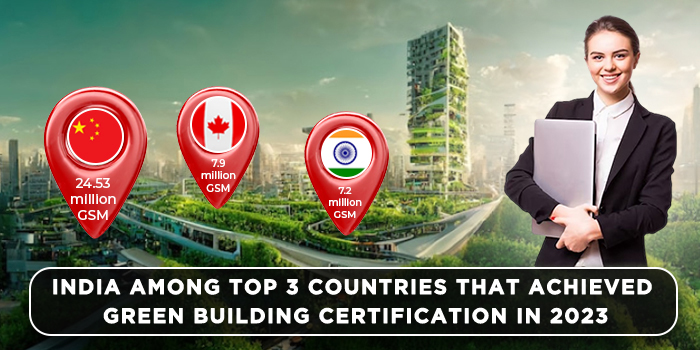

India among top 3 countries that achieved Green Building certification in 2023

India managed to stay in third spot on the US Green Building Council’s (USGBC) annual list of the top 10 countries for Leadership in Energy and Environmental Design (LEED) in 2023. The prestigious annual survey certified 248 projects in India spanning 7.2 million gross square metres (GSM). While China topped the list with upwards of 24.53 million GSM certified, Canada occupied second spot at 7.9 million GSM.

A built structure earns the moniker of a “green building” when it puts the natural environment at the heart of its form and function. This is done by using sustainable materials in construction and optimization of natural resources like water, light and air to improve energy efficiency and ensure better ventilation. Such buildings produce less non-biodegradable waste and gives healthier indoor air quality to occupants.

The pandemic which turned our world upside down, has had one positive impact on our lives, though. It has brought us back in touch with Nature, leading to a renewed interest and traction for green buildings, as more and more people are now concerned about the ecological footprints their residences or offices are leaving on the environment.

Over the past few years, India has demonstrated an unwavering commitment towards achieving UN Sustainable Development Goals fixed for 2030 by consistently ranking within the top-three bracket. This is a clear indication on the country’s sharp focus on combating climate change by stressing on environmentally conscious practices. LEED in India is administered by the Green Building Certification Inc. (GBCI) which has been advocating the merits of sustainable construction practices across the country.

The consensus-based rating system was formulated keeping in mind tech inputs and raw materials that can be easily sourced in today’s market scenario, with the objective of promoting the use of local resources for design and construction, energy efficiency, water conservation, reduced use of fossil fuels and responsible handling of domestic waste to protect the environment.

The system is both prescription- and performance-based, appraising mandatory requirements as well as credit points and is designed to be user-friendly. The primary concern is the quality of life that occupants can expect, assessed based on national as well as global parameters.

The benefits of Green New Buildings certified by GBCI are numerous, whether tangible or intangible. The tangible benefits for occupants would primarily include a significant reduction in power and water consumption. While water use could be cut down by 30 to 50 per cent, a 20 to 30 per cent reduction in energy spending could be achieved in the best-case scenario.

The intangible advantages are no less critical and would include superior indoor air quality, lots of natural light filtering in, leading to significant health and well-being benefits for occupants, and of course safeguarding natural resources which are finite, besides more efficient handling of waste. All these pluses automatically result in enhanced resale value of the property.

According to Gopalakrishnan Padmanabhan, MD – Southeast Asia & Middle East, GBCI: “With India’s rapidly growing urban landscape, investment in green buildings becomes imperative, which extends beyond resource efficiency and reduced environmental impact. India’s consistent presence among the top countries for LEED underscores the dedicated pursuit of sustainable living and widespread adoption of green buildings.”

Disclaimer : Information contained and transmitted by us are for information purposes only. All views and/or recommendations are those of the concerned author personally and made purely for information purposes. Nothing contained in the articles should be construed as business, legal, tax, accounting, investment or other advice or as an advertisement or promotion of any project or developer or locality. Pioneer Property Management Ltd. does not offer any such advice. No warranties, guarantees, promises and/or representations of any kind, express or implied, are given as to (a) the nature, standard, quality, reliability, accuracy or otherwise of the information and views provided in (and other contents of) the articles or (b) the suitability, applicability or otherwise of such information, views, or other contents for any person’s circumstances. We shall not be liable nor shall be held responsible in any manner for any action taken based on the published information (whether in law, contract, tort, by negligence, products liability or otherwise) for any losses, injury or damage (whether direct or indirect, special, incidental or consequential) suffered by such person as a result of anyone applying the information (or any other contents) in these articles or making any investment decision on the basis of such information (or any such contents), or otherwise. The users should exercise due caution and/or seek independent advice before they make any decision or take any action on the basis of such information or other contents.
Reduced stamp duty rate in West Bengal

Home-buyers in Bengal have been treated to a second bonanza in the space of a few months in terms of stamp duty obligations. After extending the existing rebate in stamp duty for registration of properties and circle rate till June 2024 last September, the state has now capped stamp duty at Rs 1000 regardless of the circle rate value on the property if the transfer is a gift within the family.

The flat-rate relief for intra-family transfer of properties was proposed in the state Budget tabled recently. Till now, any transaction of property within the family entails a special stamp duty rate of 0.5% of the prevailing circle rate value. Industry experts have hailed this move as beneficial to everybody, making gift-deed property transfers far simpler than before.

Elderly members of most families owning immovable property like a flat, house or land parcel would like to gift it to a family member – son, daughter, spouse, daughter-in-law, grandchild, or a sibling. This latest move for a uniform stamp duty cap for any location would be a huge plus for these people. Just to illustrate the point, while the circle-rate value of a certain property valued at Rs 2 crore would have meant a stamp duty payout of Rs 1 lakh, it would now come to a mere Rs 1000.

When a family elder does succession planning, there are usually two routes – draw up a will or write a gift deed. The latter is often the preferred choice, because albeit a will doesn’t entail any stamp duty, there are legal complexities involved. For instance, there could be legal challenges and dispute over the property among family members themselves, or some other roadblock during execution of the will.

The blanket stamp duty discount was first declared in the July 2021 state budget at the beginning of the third term of the ruling regime. The idea was to offer some leeway to home-buyers ravaged by the pandemic and also with an eye to boosting market sentiment and creating fresh employment at a time when so many jobs were lost. Since the first announcement, the sop period has been extended a few times and according to market sources, in the Kolkata Metropolitan Area itself, over 100,000 properties have been registered during this period.

Factors influencing stamp duty in West Bengal:

# Location of the property: Stamp duty and registration fees are higher in cities than in rural areas. Hence, the same property valued at Rs 1 crore will attract a stamp duty plus registration fee of 5% in rural areas and 6% in urban precincts.

# Value of the property: While properties going up to Rs 1 crore entails stamp duty and registration fee of 5% and 6% in rural and urban areas, respectively, for a property worth Rs 2 crore, the rates would spike to 6% and 7%, correspondingly.

Disclaimer : Information contained and transmitted by us are for information purposes only. All views and/or recommendations are those of the concerned author personally and made purely for information purposes. Nothing contained in the articles should be construed as business, legal, tax, accounting, investment or other advice or as an advertisement or promotion of any project or developer or locality. Pioneer Property Management Ltd. does not offer any such advice. No warranties, guarantees, promises and/or representations of any kind, express or implied, are given as to (a) the nature, standard, quality, reliability, accuracy or otherwise of the information and views provided in (and other contents of) the articles or (b) the suitability, applicability or otherwise of such information, views, or other contents for any person’s circumstances. We shall not be liable nor shall be held responsible in any manner for any action taken based on the published information (whether in law, contract, tort, by negligence, products liability or otherwise) for any losses, injury or damage (whether direct or indirect, special, incidental or consequential) suffered by such person as a result of anyone applying the information (or any other contents) in these articles or making any investment decision on the basis of such information (or any such contents), or otherwise. The users should exercise due caution and/or seek independent advice before they make any decision or take any action on the basis of such information or other contents.

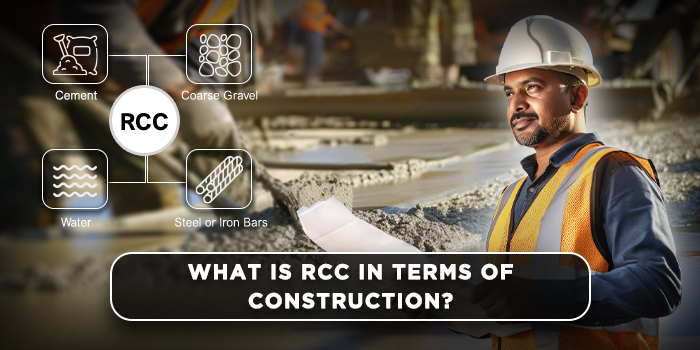
What is RCC in terms of construction?

RCC or reinforced cement concrete is a combination of cement, coarse gravel and water, which uses reinforcing steel or iron bars embedded in the concrete to enhance the strength and stability. It helps distribute pressure and stress evenly throughout the material. The concrete and reinforcement complement each other to form building blocks.

This renders RCC doubly resistant to compressive loading and a lot less vulnerable to disintegrating under tensile stress. Moreover, being more durable compared to traditional concrete, it has a longer life and rarely needs repairs. With all these pluses, besides being cost-effective, RCC has now become the default setting in the construction industry.

The 3 types of reinforced concrete in use are:

# Fibre reinforced concrete: This type uses mineral, steel and organic fibres and are primarily used in contemporary buildings and sidewalk overlays and offers uniform tensile strength at a reasonable cost.

# Polymer concrete: This group of RCC involves use of polymer binders in place of cement hydrate binders of traditional cement concrete en masse. The result is superior strength, adhesion, better scratch and chemical-resistance compared to standard concrete. Polymerization of binders at ambient temperatures causes polymeric concrete to harden.

# Ferrocement concrete: Cement mortar is mixed with wire meshes to prepare this type of concrete. Being lightweight and very adaptable, this concrete can be moulded into any desired shape. The material cost is lower, it is easy to construct and has a long life while being resilient to earthquakes.

What are the advantages of RCC?

# Offers superior tensile and compressive strength in comparison with other building materials.

# RCC buildings provide better longevity.

# Reinforced concrete can be cast into different moulds before the mix hardens.

# RCC structures have lower maintenance cost.

# RCC buildings offer better resistance to fire and quakes than steel-only structures.

# Level of workers’ skills required in the construction of RCC buildings is lower than that for steel structures.

Earlier, when most structures were built of concrete, often structural stability of the buildings would be below par, leading to an early collapse. This happened because concrete was not treated to withstand tensile pressure generated by the structures. On the contrary, buildings erected with RCC construction are much better equipped to handle tensile pressure and hence, has become so popular these days.

The real estate sector has come a long way and RCC is clearly the future of construction technology, driving sweeping changes in the industry, making brickworks gradually outdated. These changes, powered by constant investment in R&D, are also significantly contributing to the country’s economic growth

Disclaimer : Information contained and transmitted by us are for information purposes only. All views and/or recommendations are those of the concerned author personally and made purely for information purposes. Nothing contained in the articles should be construed as business, legal, tax, accounting, investment or other advice or as an advertisement or promotion of any project or developer or locality. Pioneer Property Management Ltd. does not offer any such advice. No warranties, guarantees, promises and/or representations of any kind, express or implied, are given as to (a) the nature, standard, quality, reliability, accuracy or otherwise of the information and views provided in (and other contents of) the articles or (b) the suitability, applicability or otherwise of such information, views, or other contents for any person’s circumstances. We shall not be liable nor shall be held responsible in any manner for any action taken based on the published information (whether in law, contract, tort, by negligence, products liability or otherwise) for any losses, injury or damage (whether direct or indirect, special, incidental or consequential) suffered by such person as a result of anyone applying the information (or any other contents) in these articles or making any investment decision on the basis of such information (or any such contents), or otherwise. The users should exercise due caution and/or seek independent advice before they make any decision or take any action on the basis of such information or other contents.

Tips for hosting a splendid house party

Great house parties are always those where everyone seems to be having a wonderful time, guests and hosts alike, without anyone seeming to break much of a sweat. Great camaraderie, lip-smacking snacks, foot-stomping music and your favourite cocktails. When all these elements fall in place like clockwork, it’s the magic of the perfect house do. However, a lot of behind-the-scenes effort will have gone into curating this magical evening.

Let us look at some of the elements that make a great house party:

# Clear the clutter: The first step is to ensure you create enough clutter-free space in the main hosting area for the guests to move around freely. For this, if you have to move or rearrange furniture, so be it. A tidy hosting area exudes warmth and joy and feels particularly welcoming.

# Right lights create great vibes: By using pretty lamp shades and elegant pedestal lights innovatively, you can accentuate the beautiful nooks and crannies of your home and create a sense of magic. Right use of lights can indeed bring on that X-factor to your house party, creating a mesmerizing ambience.

# Music sets the mood: Once you have got the space and lighting arrangements sorted, the next task is to create a swinging playlist of the right music to liven up the party. Spend some time ahead of the special day to curate this playlist with care so that the music never stops during the party and everybody has a wonderful time even during breaks in conversation.

# Sip and bite: While it’s advisable to keep your bar cabinet properly stocked and diverse so that the guests never have their glasses empty, when it comes to food, it’s always sensible to have more finger-food options. Bite-sized snacks always go well with drinks and conversation, and hence are almost always the preferred choice of guests, often stretching onto well beyond dinner time.

# Let your neighbours know: It’s a great idea to keep your next-door neighbours apprised of your house party plans so that they are not stumped by the late-night loud music and all. So instead of cursing under their breath, it’s more likely that they will accept it in good humour and might also volunteer to join in and help out.

# Keep the washroom clean: Your guests will almost certainly need to use the washroom at least once during the course of the party. So, take care to keep the facility clean and deodorized, while making sure there are enough tissues, toilet paper, handwash, hand-towel, etc.

# Prep well ahead: You must make it a point to complete all your preparation before the first guests arrive. This is in particular regard to the food spread planned, more so if you are cooking at home. Make sure food can be put on the table with the minimum of fuss and complex, last-minute chores can be avoided. Little details if attended to early, can add so much more fun and easy flow to the party.

You are all set now. Let the party begin…

Disclaimer : Information contained and transmitted by us are for information purposes only. All views and/or recommendations are those of the concerned author personally and made purely for information purposes. Nothing contained in the articles should be construed as business, legal, tax, accounting, investment or other advice or as an advertisement or promotion of any project or developer or locality. Pioneer Property Management Ltd. does not offer any such advice. No warranties, guarantees, promises and/or representations of any kind, express or implied, are given as to (a) the nature, standard, quality, reliability, accuracy or otherwise of the information and views provided in (and other contents of) the articles or (b) the suitability, applicability or otherwise of such information, views, or other contents for any person’s circumstances. We shall not be liable nor shall be held responsible in any manner for any action taken based on the published information (whether in law, contract, tort, by negligence, products liability or otherwise) for any losses, injury or damage (whether direct or indirect, special, incidental or consequential) suffered by such person as a result of anyone applying the information (or any other contents) in these articles or making any investment decision on the basis of such information (or any such contents), or otherwise. The users should exercise due caution and/or seek independent advice before they make any decision or take any action on the basis of such information or other contents.

Why home buyers should opt for green buildings

The vagaries of climate change, an exponential rise in urbanization and an ever-escalating demand for energy have all combined to add to the clamour for more and more sustainable buildings around the world, and the Indian realty sector is no exception. The chorus for green buildings and sustainable living continues to get louder by the day.

So, what is a sustainable building? Sustainable construction is a method of building that minimizes harm to the environment. It’s not only about being energy-efficient, such eco-friendly homes have intelligent design, use sustainable materials and new-age technologies to ensure minimum harm comes to the environment by reducing waste, saving water and cutting energy use.

The number of real estate projects that secured a LEED certification (an approval system for eco-friendly buildings) last year crossed 5000, according to a recent survey, underlining the growing trend towards sustainable construction. This green switch is clearly driving significant growth in the Indian realty sector, with an average growth of 6%-plus forecast till 2026 at least.

Here are some methods of sustainable construction:

# Using solar power: Green building technology uses solar energy in a big way. While solar panels can be used to turn the sun’s energy into electricity, passive solar energy can also be used to keep the buildings warm in cold-climate zones, by intelligent placing of windows.

# Using biodegradable materials: Green buildings use materials like bamboo, wood, straw, cork, etc. which break down without causing harm to the environment.

# Using insulation: Eco-friendly construction uses recycled materials like old denim or paper for insulation to keep buildings warm or cool, thus helping save energy.

# Using intelligent roofing: Sustainable construction uses cool roofs that reflect sunlight, thus keeping buildings cooler. This means less need for air-conditioning and reduction of greenhouse gases emission.

# Using smart water tech: Saving and wise management of water is a key pillar of green buildings. Smart technologies like rainwater harvesting, reuse of greywater and using the right fixtures are all adopted to achieve this.

# Ensuring optimum indoor air quality: In order to control the indoor environment, green buildings use ingredients that don’t emit toxic chemicals while controlling moisture levels, thus ensuring the air inside is safe and healthy.

# Using smart design: A passive house design can help manage temperature without using gadgets for cooling or heating. This can result in up to 90% energy savings.

What are the rewards of sustainable construction?

# Environment protection: It reduces impact on the environment by reducing pollution and waste and wise use of water and energy.

# Boosts economy: By creating more jobs and adding traction to the realty market, it provides a shot in the arm to the economy.

# More resilient: Green buildings offer better protection against climate change and extreme weather events.

# Promotes good health: Thanks to the superior indoor air quality and access to more natural light, green buildings are healthier to live in.

# Cutting-edge tech: Use of more evolved construction technology makes sustainable construction smarter and more environment-friendly.

# Better performance: Green buildings easily outperform their conventional counterparts by using less power and water and reducing waste and pollution.

Disclaimer : Information contained and transmitted by us are for information purposes only. All views and/or recommendations are those of the concerned author personally and made purely for information purposes. Nothing contained in the articles should be construed as business, legal, tax, accounting, investment or other advice or as an advertisement or promotion of any project or developer or locality. Pioneer Property Management Ltd. does not offer any such advice. No warranties, guarantees, promises and/or representations of any kind, express or implied, are given as to (a) the nature, standard, quality, reliability, accuracy or otherwise of the information and views provided in (and other contents of) the articles or (b) the suitability, applicability or otherwise of such information, views, or other contents for any person’s circumstances. We shall not be liable nor shall be held responsible in any manner for any action taken based on the published information (whether in law, contract, tort, by negligence, products liability or otherwise) for any losses, injury or damage (whether direct or indirect, special, incidental or consequential) suffered by such person as a result of anyone applying the information (or any other contents) in these articles or making any investment decision on the basis of such information (or any such contents), or otherwise. The users should exercise due caution and/or seek independent advice before they make any decision or take any action on the basis of such information or other contents.

Importance of colours in Vastu science

When we think of colours, we often think of decoration or a spruce-up. However, colours are much more than just embellishment. Different shades have differing impacts on our emotional make-up, chain of thought and even the way we act or react. Not only this, each colour has unique properties that have an effect on our health, happiness, career path, etc, according to Vastu science.

Vastu Shastra or Vedic Astrology is an age-old science that works by harnessing energies, by channeling positive verve into our homes. When done right, this can pave the way for good luck, peace of mind and a sense of positivity in our thought process, the science maintains. Activation of positive energy is done by using specific shades for different directions and zones, designed to abate the negative influence of each element.

Very often, we take care to ensure that all objects are placed in the right direction as per Vastu science, preserving the equilibrium among the five natural elements. Still, we aren’t getting the desired effects. Perhaps, we have forgotten to use recommended colours for specific living spaces as suggested by Vastu.

After all, different colours affect our mood, sentiments and physical energy in different ways, since each shade has its own vibration or wavelength. In our subconscious, we react to the colours surrounding us, soaking in their characteristics easily. A specific wall colour will either make you feel comfortable and relaxed, or cause some unease and stress. Hence, this harmony between living spaces and colours used is very important, according to Vastu.

Appropriate colour schemes for various living spaces

# Living room: This is where we spend a lot of time with our family and also entertain guests. Since this is the section of our home open to outsiders, the place should always exude warmth and positive energy. This happy mood can be accentuated by shades like light yellow, light green, or even beige.

# Bedroom: This is the most private section of your home, where you can just be yourself, without the need for masking your feelings. This is where you can share your innermost sentiments, strengths and flaws. To ward off negative thoughts and energies, you can go for colours like pale green, lavender and a range of shades from the blue family.

# Kitchen: Food is not only for sustenance and nutrition, it also excites us and is a reason to come together. The kitchen is where our meals are prepared with love and affection. It’s wise to use happy colours like orange, yellow, rose or red. Steer clear of black.

# Kids’ room: Children always have energy to burn and they need this boundless energy to be channeled into a positive direction. Vibrant colours like bright red, orange, yellow or pink usually go well in kids’ rooms, promoting gainful engagement.

# Bathroom: This is also a private space where we like to get rid of our negative energies and emerge fresh and clean from. A neutral colour palette should be the ideal choice for bathrooms.

Disclaimer : Information contained and transmitted by us are for information purposes only. All views and/or recommendations are those of the concerned author personally and made purely for information purposes. Nothing contained in the articles should be construed as business, legal, tax, accounting, investment or other advice or as an advertisement or promotion of any project or developer or locality. Pioneer Property Management Ltd. does not offer any such advice. No warranties, guarantees, promises and/or representations of any kind, express or implied, are given as to (a) the nature, standard, quality, reliability, accuracy or otherwise of the information and views provided in (and other contents of) the articles or (b) the suitability, applicability or otherwise of such information, views, or other contents for any person’s circumstances. We shall not be liable nor shall be held responsible in any manner for any action taken based on the published information (whether in law, contract, tort, by negligence, products liability or otherwise) for any losses, injury or damage (whether direct or indirect, special, incidental or consequential) suffered by such person as a result of anyone applying the information (or any other contents) in these articles or making any investment decision on the basis of such information (or any such contents), or otherwise. The users should exercise due caution and/or seek independent advice before they make any decision or take any action on the basis of such information or other contents.

Biggest spike in demand for luxury homes

Glossy entrance lobby with waiting lounge for guests. Outdoor areas with large patios. Bar zones and fire pits. Rooftop gardens, private pools and water walls. Top-of-the-line gym, high-speed elevators, clubhouse with tennis and billiards. Tick for all, because luxe is in.

Demand for premium homes has shot through the roof during the first eight months of this year, with luxury properties registering a staggering 130% growth and developers scrambling to cater to this significant surge, according to industry experts. They feel the combination of a buoyant economy, political stability, increased interest from HNIs and NRIs and a tilt towards aspirational investments is fueling this growth.

A look at the factors driving growth in luxury segment

# Buoyant economy: India’s robust economic growth and the emergence of diverse business models, have led to a burgeoning affluent population and large-scale urbanization, triggering more investments and subsequently, a soaring demand for premium homes.

# Lifestyle investment: With the increase in buying power, the aspiration levels have also gone up and investing in a better lifestyle has become more important. A prime want is a large home with premium features, sometimes even a second home. Post-Covid, the demand for larger living spaces has organically soared because people are spending more time at home with the WFH or hybrid work models.

# Traction from HNIs and UHNIs: For high-net-worth individuals (HNIs) and ultra-high-net-worth individuals (UHNIs), the real estate market is always a trusted safeguard against the vagaries of inflation. Post-pandemic, more than ever before, they are keen to park their money in luxury real estate.

# Demand from NRIs: The strengthening of the US dollar against the Indian rupee has stoked the interest of NRIs and there is an increased demand for high-end units from that segment. Also, with the rise in raw material prices like cement and steel, property prices are set to move northwards only. So, this is a great time to invest, concur market watchers.

# Cap on capital gains: Another factor going in favour of this trend of going for luxury homes is the government move to cap capital gains at Rs 10 crore in the Union Budget.

According to market sources, premium properties priced at Rs 1.5 crore and above accounted for nearly 20% of all residential units transacted in the leading cities of India over the past 18 months, as opposed to only 6.8% luxury homes sold during 2019. The continued traction in the premium segment after the pandemic has enabled developers to clear large portions of their inventories.

This positive sentiment in favour of luxury homes with a plethora of built-in amenities is expected to become more pronounced in the near-to-medium term, with the demand surge breaking new barriers. This is elixir for real estate developers after the slump during the pandemic period and the leading players are all ready to roll out high-end residential projects packed with the latest lavish features as they ride the premium crest.

Disclaimer : Information contained and transmitted by us are for information purposes only. All views and/or recommendations are those of the concerned author personally and made purely for information purposes. Nothing contained in the articles should be construed as business, legal, tax, accounting, investment or other advice or as an advertisement or promotion of any project or developer or locality. Pioneer Property Management Ltd. does not offer any such advice. No warranties, guarantees, promises and/or representations of any kind, express or implied, are given as to (a) the nature, standard, quality, reliability, accuracy or otherwise of the information and views provided in (and other contents of) the articles or (b) the suitability, applicability or otherwise of such information, views, or other contents for any person’s circumstances. We shall not be liable nor shall be held responsible in any manner for any action taken based on the published information (whether in law, contract, tort, by negligence, products liability or otherwise) for any losses, injury or damage (whether direct or indirect, special, incidental or consequential) suffered by such person as a result of anyone applying the information (or any other contents) in these articles or making any investment decision on the basis of such information (or any such contents), or otherwise. The users should exercise due caution and/or seek independent advice before they make any decision or take any action on the basis of such information or other contents.

Taking pride in our built heritage

The Christmas-New Year festive season is almost upon us. It’s that time of the year when Kolkata decks up for the yearend carnival and endless partying. There’s a sense of bonhomie and bonding all around. This is also the time when we make our New Year promises. This time, why don’t we vow to appreciate our amazing architectural legacy a little more?

Kolkata’s rich literary, artistic and cinematic heritage is universally acknowledged and celebrated, but our built heritage rarely features in our daily discourse. Isn’t it kind of strange, considering that the city’s part-European, part-Bengali architectural mélange is so distinctive, it has fascinated eminent architects and urban planners around the world for decades? Is it a case of ‘familiarity breeds contempt’?

The intricate cornices, high ceilings, wrought-iron grilles, crescent-shaped verandahs and slatted windows are all a vibrant reminder of our colonial-style built heritage, seamlessly intertwined with an aristocratic Bengali design vocabulary. Elegant and profound, yet charming and beautiful. As Nobel Laureate Amartya Sen describes Kolkata’s historic built environment: “Calcutta’s eccentric but exciting old buildings.”

A walk around the BBD Bag business precincts reinforces the belief that Kolkata had the trappings to become one of the world’s most magnificent cities. Maybe somewhere down the line, we lost our way. Most of the splendid edifices are in various stages of decay and disrepair and crumbling even as we speak. So, are those priceless structures like St. James’ Church or the GPO with its majestic dome, the Writers’ Buildings, et all beyond salvage?

While the Currency Building is the only concrete example of a prominent heritage structure restoration in the CBD till date, there seem to be a clutch of piecemeal plans like restoration of St. James’ Church, beautifying a stretch in front of the GPO, an extension of the Millennium Park, etc. The beautifully conceived Palladian Lounge in the BCCI building was meant to be an oasis, attracting people back to the office para after dark through its myriad events and expos and fine-dining spread.

However, it needed greater traction to engineer a more widespread urban renewal wave in the Dalhousie Square area. While so much could be done along the riverfront, linking it like a ‘T’ with BBD Bag, there were some setbacks that have stymied efforts to steer a holistic regeneration. First, the planned adaptive retail-and-entertainment reuse of the revamped 16 Strand Road (Mackinnon & Mackenzie House) didn’t come off, then the pilot beautification project between the two bridges is yet to take concrete shape. And of course, there was the devastating fire in one of the Strand warehouses of the Port Trust.

So, can’t we put up a united front of various stakeholders and expert groups to create a collective bandwidth to protect Kolkata’s unique built heritage? Let’s not talk about political will only, this requires healthy doses of public will as well. Citizens’ consensus is the biggest enabler in any urban renewal initiative and this can be one of the most significant inner-city rejuvenation programmes in the country. What cities like New York, London, Birmingham, Istanbul or Marrakesh have achieved through such interventions, we can replicate in our beloved Kolkata as well.

Many iconic European cities like Berlin, Vienna, Milan and Prague have shown the world how centuries-old buildings can be restored and put to intelligent adaptive reuse, including art galleries, museums (think Tate Modern) and even modern retail. All it needs is intent and a collaborative approach.

Of course, there are countless other architectural gems elsewhere in the city, like the splendid North Kolkata brick building quarters or the grand Art Deco buildings like Roxy and Metro cinemas in the Esplanade area and also Purna cinema in Bhowanipore, not to mention the beautiful, elegant and stylised old houses of South Kolkata.

However, a systematically restored and rejuvenated BBD Bag can do wonders for the image of our city and create a tourism magnet to draw people from across the country and around the world. A vibrant heritage retail and entertainment pedestrian zone can also be a massive economic energizer, which should generate captive revenue for the maintenance of the entire precincts. It sends out a strong positive signal to the outside world and goes a long way in bringing back the lost glory of Asia’s first cosmopolitan metropolis.

In India itself, Mumbai has already attempted something similar, engineering an afterhours reverse traffic flow to its CBDs in the Fort area, Cuffe Parade, Colaba and BKC, among others, creating retail and fine-dining destinations anchored by aspirational brands and elite F&B outlets. It’s a great way to keep the office districts hip and happening even after swipe-out time, while creating a whole new attraction, drawing friends and families in their hordes, giving them enough reason to spend and blow their workday blues away.

No reason why we can’t replicate a similar, why not better, experience in our own CBD. It’s a project waiting to be signed, sealed and delivered – a value-add that can have a magical ripple effect.

Disclaimer : Information contained and transmitted by us are for information purposes only. All views and/or recommendations are those of the concerned author personally and made purely for information purposes. Nothing contained in the articles should be construed as business, legal, tax, accounting, investment or other advice or as an advertisement or promotion of any project or developer or locality. Pioneer Property Management Ltd. does not offer any such advice. No warranties, guarantees, promises and/or representations of any kind, express or implied, are given as to (a) the nature, standard, quality, reliability, accuracy or otherwise of the information and views provided in (and other contents of) the articles or (b) the suitability, applicability or otherwise of such information, views, or other contents for any person’s circumstances. We shall not be liable nor shall be held responsible in any manner for any action taken based on the published information (whether in law, contract, tort, by negligence, products liability or otherwise) for any losses, injury or damage (whether direct or indirect, special, incidental or consequential) suffered by such person as a result of anyone applying the information (or any other contents) in these articles or making any investment decision on the basis of such information (or any such contents), or otherwise. The users should exercise due caution and/or seek independent advice before they make any decision or take any action on the basis of such information or other contents.

Affordable housing demand still strong

The demand for affordable housing in and around Kolkata remains strong post-pandemic, even as the entire gamut of real estate products experience a bounce-back. In fact, along with Ahmedabad and Pune, Kolkata is one of the most affordable housing markets in the country according to a recent study, with average EMI outgo accounting for 23-26 per cent of a household’s monthly income.

There are several factors responsible for the perennial affordability in the city’s realty market. Kolkata is not only a stable market, it is also largely driven by end-users, not speculators, unlike a Mumbai or a Gurgaon. Besides, a host of new growth corridors have opened up for the property market thanks to growing investment in better infrastructure and connectivity.

Some of these new affordable pockets include the Southern Bypass corridor/Sonarpur-Narendrapur, Rajarhat, New Town, BT Road, Madhyamgram, Diamond Harbour Road/Joka, while new growth areas are sprouting all across. The augmented Metro connectivity and new roads with support infrastructure have been driving this growth of affordable housing on the city’s fringes.

The government has also helped to create traction in the affordable housing segment by launching a clutch of consumer-friendly schemes in its ‘Housing for All’ initiative. Certain steps like raising the tax deduction limit for interest payment on home loans, whittling down GST rates and giving industry status to affordable housing have all added energy to this market and of late, with more and more home seekers taking the plunge. Another report points to the fact that average property prices in Kolkata have gone up by nearly 46 per cent over the past decade, a clear indication of a stable market where frequent fluctuations don’t send shivers down your spine. While there has been a perceptible rise in demand for premium projects after the pandemic, maximum sales are still recorded in the Rs 40 lakh-to-80 lakh segment.

While NRIs have traditionally looked at the Indian real estate market as a good investment option, they are now looking at the affordable property segment seriously. For one, they can leverage the government’s schemes on investing in affordable housing and reap the benefits of tax cuts and interest subsidies. Besides, with demand remaining strong, investment in this segment holds out the prospects of a steady rental income and capital appreciation. Also, this market is less prone to fluctuations and hence, offers greater peace of mind.

So, in terms of both risk reduction and profit maximization, the affordable housing segment offers a wonderful avenue for diversification of their investment portfolios to the NRIs. With more stocks being added to the inventory of most developers, the options are opening up even more.

Disclaimer : Information contained and transmitted by us are for information purposes only. All views and/or recommendations are those of the concerned author personally and made purely for information purposes. Nothing contained in the articles should be construed as business, legal, tax, accounting, investment or other advice or as an advertisement or promotion of any project or developer or locality. Pioneer Property Management Ltd. does not offer any such advice. No warranties, guarantees, promises and/or representations of any kind, express or implied, are given as to (a) the nature, standard, quality, reliability, accuracy or otherwise of the information and views provided in (and other contents of) the articles or (b) the suitability, applicability or otherwise of such information, views, or other contents for any person’s circumstances. We shall not be liable nor shall be held responsible in any manner for any action taken based on the published information (whether in law, contract, tort, by negligence, products liability or otherwise) for any losses, injury or damage (whether direct or indirect, special, incidental or consequential) suffered by such person as a result of anyone applying the information (or any other contents) in these articles or making any investment decision on the basis of such information (or any such contents), or otherwise. The users should exercise due caution and/or seek independent advice before they make any decision or take any action on the basis of such information or other contents.