

August 2025 - Pioneer Property

Data-Driven Buying — How Our Marketing Team Supports Informed Decisions?

In today’s age of sweeping technological advances, just like most other industries, the real estate sector is also poised for a game-changing data revolution. The power of data analytics has totally eclipsed traditional ways of decision-making and real estate professionals like us at Pioneer Property can glean these perspectives to help our customers make informed and precise choices.

We now have a surfeit of tools at our disposal – from artificial intelligence to machine learning to big data and predictive analysis – to decipher market trends, assess property values and take calls to stay on top of the curve in terms of trends and customer preferences. The extensive use of data, the backbone of today’s marketing, has also infused more transparency and trust in this sector.

How We Use Data in Real Estate Marketing?

    • Understanding Buyer Behaviour: We use data analytics to understand buyer behaviour comprehensively. We track their online activity on property searches, website visits and social media engagements to arrive at a complete picture of what they are looking for and their essential preferences and apprehensions. Armed with such data, we can customize our marketing strategies to meet our customers’ needs more efficiently.
    • Personalization and Targeted Approach: A blanket marketing ploy in real estate marketing doesn’t work any longer. Every buyer is his or her own person and has interests and intents which are unique to the individual. They expect a bespoke treatment and that is what we give them, mining data based on demographics, pursuits and buying intent. By using these data sets, we can curate different marketing communication modules targeted at different buyer segments. This boosts our relationships with clients and significantly improves conversion.

Illustration showing how data powers smart home buying decisions with Pioneer Property Management, highlighting connected tools and advanced technology

    • Augmenting Marketing Campaigns: Access to data gives us the opportunity to carry out a course correction if we feel any particular marketing strategy is not achieving desired results. While analysing data, we can measure the success of campaigns by checking key metrics like click-through rates, engagement and generation of leads. Based on such analyses, we keep on evolving and fine-tuning our marketing campaigns so that they are more aligned towards buyer inclinations.
    • Staying Ahead of the Curve: The real estate market is in constant churn, and predictive analytics helps us stay ahead of the curve in terms of emerging trends. This is a potent tool for us to anticipate market shifts like a particular area suddenly becoming a hotspot or specific buyer preferences hogging the spotlight. This data-driven prudence can help us cash in on the emerging trends by making informed decisions including prioritizing new projects or altering pricing strategies.
    • Boosting Customer Retention: We don’t believe in the concept of “sell it and forget it”. For us, every customer means a long-term investment in relationship and we are always there to help out in any matter, post-transaction. The use of data is extremely useful to us for monitoring post-sale customer satisfaction and figuring out what we could do to further improve our handholding. Systematically tracking consumer feedback through data can help improve buyer experience, boosting loyalty and triggering referrals.

Magnifying glass focusing on an apartment building with the message: 'Your next home isn’t a guess, it’s an insight' — promoting data-driven home buying by Pioneer Property Management

Office Relocation Checklist: What to Know Before You Move?

Moving office can be a complex process with many moving parts, from IT infrastructure to employee communication, and hence, requires careful planning and organization. For ensuring a smooth transition, it is advisable to create a timeline with critical dates and also a relocation team to carry out the entire exercise.

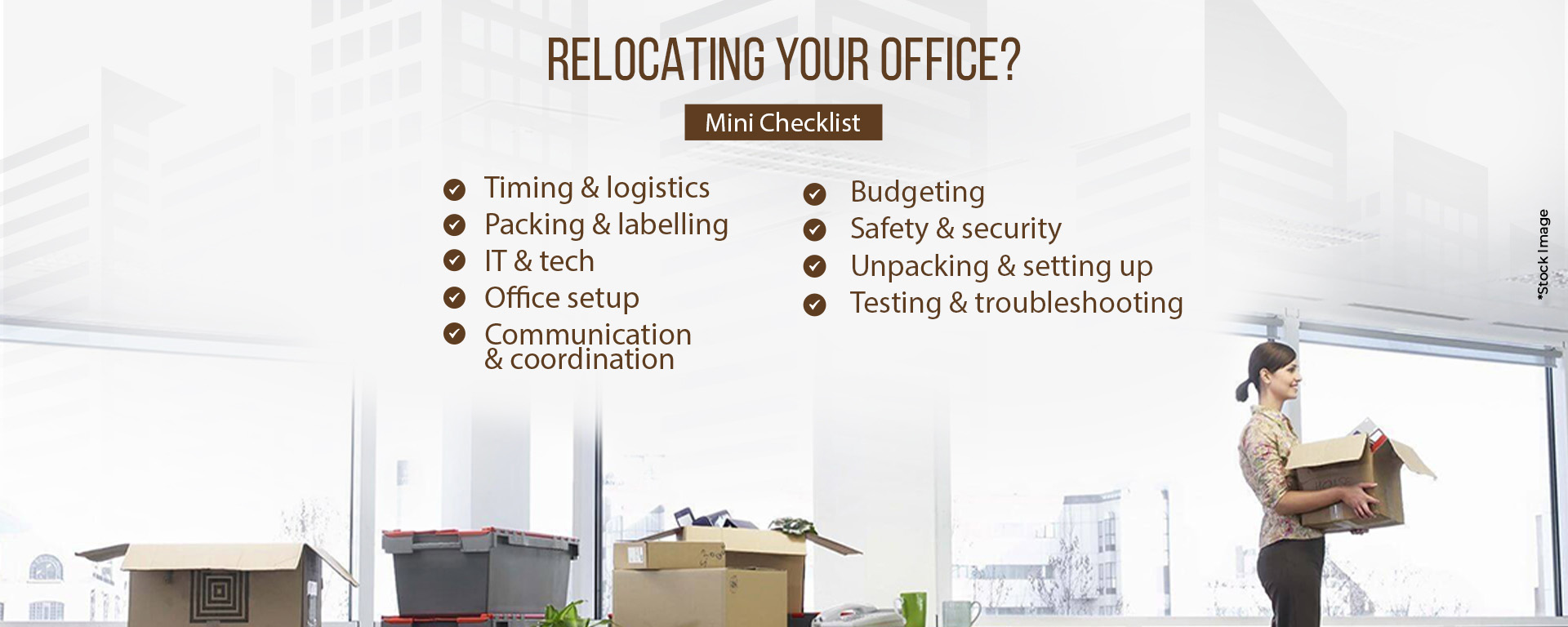
An essential checklist for smooth relocation

    • Timing and logistics: The timing of the shift is of paramount importance so as to minimize disruption to business operations. The move needs to be planned in a way so that all your employees, on-site or remote-working type, lose minimum man-days/hours. Hence, a lean period is ideal for the relocation. All the logistics including multiple vendors, packers and movers and all staff members must be coordinated with in a systematic manner to avoid confusion and chaos. The timelines for the entire infrastructure in the new office to be in place will determine how soon you can get your business operations back on track.


    • Packing and labelling: This is easily the most tedious part of shifting office. Making sure that everything, from furniture to files and all items in between, are packed properly and labelled meticulously is a major part of ensuring a smooth transition. When the packing is efficiently done and the labelling methodical, chances of items getting damaged or lost in transit can be minimized to a large extent.


    • IT and tech: Moving computers and other IT services essentials is a critical part of relocation and requires special attention to prevent damage during transportation. All important data and files must be backed up carefully and double-checked so that you don’t lose any important data. An added responsibility is to ensure that your remote and hybrid employees have uninterrupted support and seamless connectivity to help them continue working.


  • Office setup: You must have the layout of your new office fully visualized and planned beforehand. While doing this, it’s a no-brainer that you will plan for your remote and hybrid workforce, because the trend of work-from-home and hybrid work mode is set to continue and at this stage shows no signs of slowing down, according to a McKinsey survey.

The checklist that makes moving easier, safer, and smarter – Blog by Pioneer Property Management

    • Communication and coordination: It’s extremely important to ensure all your employees are totally aware of the relocation exercise and the respective schedules. Without proper knowledge and directives, they might feel totally in the dark and left out of the shifting process. This is not ideal for teamwork and the management will do well to include the staff members in every detail planning for relocation.


    • Budgeting: Managing the cost of shifting is critical to ensure that the exercise is financially feasible and doesn’t overshoot the company’s budget allocation. Thorough research on the fees and deliverables of packers and movers for similar assignments will give you a fair idea of the potential cost of relocation. Meeting all the outsourced agencies in person to clarify minute details helps avoid confusion in future and gives you a clearer idea of hidden costs, etc.


    • Safety and security: This is a priority area during a relocation exercise. While the shifting process is on, it’s important to ensure that both the premises, existing and new, are safe and secure. Make sure the doors are locked properly when everybody leaves, critical documents and valuables are securely locked up, the computers and other equipment are safe and all CCTV cameras are working properly.


    • Unpacking and setting up: This is a mammoth task and can take a lot out of your staff. It is advisable to set up the furniture and equipment first and make sure all individual belongings are secure. The next step should be securing and arranging the documents properly so that those can be accessed when required. For a hybrid setup, the support system for the remote-working staff members must be set up next, including IT support, video conferencing and cloud-based storage.


    • Testing and troubleshooting: Testing of the new setup and infrastructure is another critical milestone in relocation. This will include testing network connectivity, so that everybody is in the loop and connected. This is particularly relevant in today’s hybrid work culture. Next, all audio-video equipment must be checked to ensure video conferencing can be done without a glitch, another present-day requirement. Last but not the least, the office security system must be checked thoroughly, including access-control systems and surveillance cameras.


Relocate without the chaos, here’s your smart move guide – Blog by Pioneer Property Management