

February 2024 - Pioneer Property

Reduced stamp duty rate in West Bengal

Home-buyers in Bengal have been treated to a second bonanza in the space of a few months in terms of stamp duty obligations. After extending the existing rebate in stamp duty for registration of properties and circle rate till June 2024 last September, the state has now capped stamp duty at Rs 1000 regardless of the circle rate value on the property if the transfer is a gift within the family.

The flat-rate relief for intra-family transfer of properties was proposed in the state Budget tabled recently. Till now, any transaction of property within the family entails a special stamp duty rate of 0.5% of the prevailing circle rate value. Industry experts have hailed this move as beneficial to everybody, making gift-deed property transfers far simpler than before.

Elderly members of most families owning immovable property like a flat, house or land parcel would like to gift it to a family member – son, daughter, spouse, daughter-in-law, grandchild, or a sibling. This latest move for a uniform stamp duty cap for any location would be a huge plus for these people. Just to illustrate the point, while the circle-rate value of a certain property valued at Rs 2 crore would have meant a stamp duty payout of Rs 1 lakh, it would now come to a mere Rs 1000.

When a family elder does succession planning, there are usually two routes – draw up a will or write a gift deed. The latter is often the preferred choice, because albeit a will doesn’t entail any stamp duty, there are legal complexities involved. For instance, there could be legal challenges and dispute over the property among family members themselves, or some other roadblock during execution of the will.

The blanket stamp duty discount was first declared in the July 2021 state budget at the beginning of the third term of the ruling regime. The idea was to offer some leeway to home-buyers ravaged by the pandemic and also with an eye to boosting market sentiment and creating fresh employment at a time when so many jobs were lost. Since the first announcement, the sop period has been extended a few times and according to market sources, in the Kolkata Metropolitan Area itself, over 100,000 properties have been registered during this period.

Factors influencing stamp duty in West Bengal:

# Location of the property: Stamp duty and registration fees are higher in cities than in rural areas. Hence, the same property valued at Rs 1 crore will attract a stamp duty plus registration fee of 5% in rural areas and 6% in urban precincts.

# Value of the property: While properties going up to Rs 1 crore entails stamp duty and registration fee of 5% and 6% in rural and urban areas, respectively, for a property worth Rs 2 crore, the rates would spike to 6% and 7%, correspondingly.

Disclaimer : Information contained and transmitted by us are for information purposes only. All views and/or recommendations are those of the concerned author personally and made purely for information purposes. Nothing contained in the articles should be construed as business, legal, tax, accounting, investment or other advice or as an advertisement or promotion of any project or developer or locality. Pioneer Property Management Ltd. does not offer any such advice. No warranties, guarantees, promises and/or representations of any kind, express or implied, are given as to (a) the nature, standard, quality, reliability, accuracy or otherwise of the information and views provided in (and other contents of) the articles or (b) the suitability, applicability or otherwise of such information, views, or other contents for any person’s circumstances. We shall not be liable nor shall be held responsible in any manner for any action taken based on the published information (whether in law, contract, tort, by negligence, products liability or otherwise) for any losses, injury or damage (whether direct or indirect, special, incidental or consequential) suffered by such person as a result of anyone applying the information (or any other contents) in these articles or making any investment decision on the basis of such information (or any such contents), or otherwise. The users should exercise due caution and/or seek independent advice before they make any decision or take any action on the basis of such information or other contents.
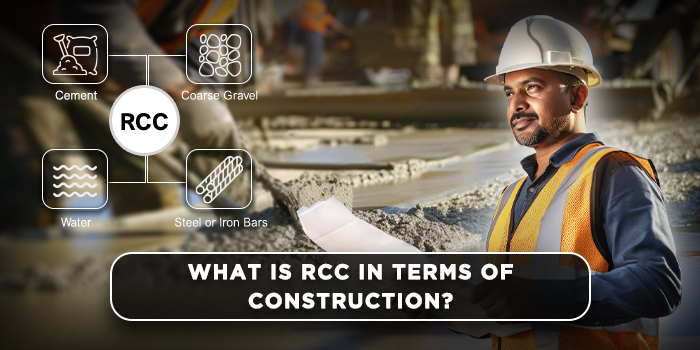

What is RCC in terms of construction?

RCC or reinforced cement concrete is a combination of cement, coarse gravel and water, which uses reinforcing steel or iron bars embedded in the concrete to enhance the strength and stability. It helps distribute pressure and stress evenly throughout the material. The concrete and reinforcement complement each other to form building blocks.

This renders RCC doubly resistant to compressive loading and a lot less vulnerable to disintegrating under tensile stress. Moreover, being more durable compared to traditional concrete, it has a longer life and rarely needs repairs. With all these pluses, besides being cost-effective, RCC has now become the default setting in the construction industry.

The 3 types of reinforced concrete in use are:

# Fibre reinforced concrete: This type uses mineral, steel and organic fibres and are primarily used in contemporary buildings and sidewalk overlays and offers uniform tensile strength at a reasonable cost.

# Polymer concrete: This group of RCC involves use of polymer binders in place of cement hydrate binders of traditional cement concrete en masse. The result is superior strength, adhesion, better scratch and chemical-resistance compared to standard concrete. Polymerization of binders at ambient temperatures causes polymeric concrete to harden.

# Ferrocement concrete: Cement mortar is mixed with wire meshes to prepare this type of concrete. Being lightweight and very adaptable, this concrete can be moulded into any desired shape. The material cost is lower, it is easy to construct and has a long life while being resilient to earthquakes.

What are the advantages of RCC?

# Offers superior tensile and compressive strength in comparison with other building materials.

# RCC buildings provide better longevity.

# Reinforced concrete can be cast into different moulds before the mix hardens.

# RCC structures have lower maintenance cost.

# RCC buildings offer better resistance to fire and quakes than steel-only structures.

# Level of workers’ skills required in the construction of RCC buildings is lower than that for steel structures.

Earlier, when most structures were built of concrete, often structural stability of the buildings would be below par, leading to an early collapse. This happened because concrete was not treated to withstand tensile pressure generated by the structures. On the contrary, buildings erected with RCC construction are much better equipped to handle tensile pressure and hence, has become so popular these days.

The real estate sector has come a long way and RCC is clearly the future of construction technology, driving sweeping changes in the industry, making brickworks gradually outdated. These changes, powered by constant investment in R&D, are also significantly contributing to the country’s economic growth

Disclaimer : Information contained and transmitted by us are for information purposes only. All views and/or recommendations are those of the concerned author personally and made purely for information purposes. Nothing contained in the articles should be construed as business, legal, tax, accounting, investment or other advice or as an advertisement or promotion of any project or developer or locality. Pioneer Property Management Ltd. does not offer any such advice. No warranties, guarantees, promises and/or representations of any kind, express or implied, are given as to (a) the nature, standard, quality, reliability, accuracy or otherwise of the information and views provided in (and other contents of) the articles or (b) the suitability, applicability or otherwise of such information, views, or other contents for any person’s circumstances. We shall not be liable nor shall be held responsible in any manner for any action taken based on the published information (whether in law, contract, tort, by negligence, products liability or otherwise) for any losses, injury or damage (whether direct or indirect, special, incidental or consequential) suffered by such person as a result of anyone applying the information (or any other contents) in these articles or making any investment decision on the basis of such information (or any such contents), or otherwise. The users should exercise due caution and/or seek independent advice before they make any decision or take any action on the basis of such information or other contents.

Tips for hosting a splendid house party

Great house parties are always those where everyone seems to be having a wonderful time, guests and hosts alike, without anyone seeming to break much of a sweat. Great camaraderie, lip-smacking snacks, foot-stomping music and your favourite cocktails. When all these elements fall in place like clockwork, it’s the magic of the perfect house do. However, a lot of behind-the-scenes effort will have gone into curating this magical evening.

Let us look at some of the elements that make a great house party:

# Clear the clutter: The first step is to ensure you create enough clutter-free space in the main hosting area for the guests to move around freely. For this, if you have to move or rearrange furniture, so be it. A tidy hosting area exudes warmth and joy and feels particularly welcoming.

# Right lights create great vibes: By using pretty lamp shades and elegant pedestal lights innovatively, you can accentuate the beautiful nooks and crannies of your home and create a sense of magic. Right use of lights can indeed bring on that X-factor to your house party, creating a mesmerizing ambience.

# Music sets the mood: Once you have got the space and lighting arrangements sorted, the next task is to create a swinging playlist of the right music to liven up the party. Spend some time ahead of the special day to curate this playlist with care so that the music never stops during the party and everybody has a wonderful time even during breaks in conversation.

# Sip and bite: While it’s advisable to keep your bar cabinet properly stocked and diverse so that the guests never have their glasses empty, when it comes to food, it’s always sensible to have more finger-food options. Bite-sized snacks always go well with drinks and conversation, and hence are almost always the preferred choice of guests, often stretching onto well beyond dinner time.

# Let your neighbours know: It’s a great idea to keep your next-door neighbours apprised of your house party plans so that they are not stumped by the late-night loud music and all. So instead of cursing under their breath, it’s more likely that they will accept it in good humour and might also volunteer to join in and help out.

# Keep the washroom clean: Your guests will almost certainly need to use the washroom at least once during the course of the party. So, take care to keep the facility clean and deodorized, while making sure there are enough tissues, toilet paper, handwash, hand-towel, etc.

# Prep well ahead: You must make it a point to complete all your preparation before the first guests arrive. This is in particular regard to the food spread planned, more so if you are cooking at home. Make sure food can be put on the table with the minimum of fuss and complex, last-minute chores can be avoided. Little details if attended to early, can add so much more fun and easy flow to the party.

You are all set now. Let the party begin…

Disclaimer : Information contained and transmitted by us are for information purposes only. All views and/or recommendations are those of the concerned author personally and made purely for information purposes. Nothing contained in the articles should be construed as business, legal, tax, accounting, investment or other advice or as an advertisement or promotion of any project or developer or locality. Pioneer Property Management Ltd. does not offer any such advice. No warranties, guarantees, promises and/or representations of any kind, express or implied, are given as to (a) the nature, standard, quality, reliability, accuracy or otherwise of the information and views provided in (and other contents of) the articles or (b) the suitability, applicability or otherwise of such information, views, or other contents for any person’s circumstances. We shall not be liable nor shall be held responsible in any manner for any action taken based on the published information (whether in law, contract, tort, by negligence, products liability or otherwise) for any losses, injury or damage (whether direct or indirect, special, incidental or consequential) suffered by such person as a result of anyone applying the information (or any other contents) in these articles or making any investment decision on the basis of such information (or any such contents), or otherwise. The users should exercise due caution and/or seek independent advice before they make any decision or take any action on the basis of such information or other contents.