

August 2022 - Pioneer Property

Simple home-improvement solutions

We often wonder how to give our home a makeover without spending a fortune on total overhaul. Well, all you need to do is to settle on some overarching theme and let your creative juices flow. The tiniest of DIY changes can sometimes have a huge impact and make your old home look sparkling new. It just requires a little bit of work and of course your bright ideas.

Here are some simple tips to make your home look better:

# Go for a fresh coat of paint: You will be surprised what a fresh coat of paint can do to lift your old home. You can try an accent wall on your living room or bedroom and go for a painted ceiling. While at it, repainting your kitchen cabinet isn’t a bad idea.

# Replace old fixtures: Replacing old light fixtures and ceiling fans with new, contemporary-design fittings can have a dramatic impact. Cutting-edge designs are easily available these days and with the wiring already in place, old fixtures can be easily replaced.

# Swap white light with yellow: While on light fixtures, replacing the white bulbs in your home with calming yellow ones is another simple trick that can bring about a significant transformation in the ambience of your home and impart a pleasant yellow glow. Also, replacing standard light switches with dimmers can enable you to control the brightness and set the mood.

# Maximize unused corners: We all have nooks and corners in our home which lie largely unused. A simple DIY solution is putting up some simple floating shelves in those corners. Not only will you have extra storage space, it will enhance the look and feel and liven up your home.

# Refurbish old furniture: We often feel tired of the looks of our same old furniture which are otherwise in perfect working condition. Simple DIY solutions like painting, reupholstering and altering their placements can make those look bright and new again.

# Bring in the green: Install potted plants and flowers to freshen up your home and add a dose of greenery and vitality to your home. There are certain tough plant species which don’t require too much care and watering, in case you are short on time.

# Do up the entrance: While this area is perhaps the most used, it often remains neglected as being just the means of entry and egress. However, simple upgrades like putting up a few paintings on the walls, placing a bench or throwing in a new rug can work wonders to create an impactful impression for those stepping in.

# Create a pet corner: By creating a special space for your pet, you not only give them excitement and gratification, it also serves to brighten up your home. Some simple additions can include wall-fitted jungle gyms, tiny water fountains, etc.

# Install smart features: These days, you can easily turn your old home into a new smart home by installing some smart features like camera-enabled doorbells, self-programmable thermostats and many more such smart gadgets readily available.

# Cut the clutter: Unseemly chords hanging from your TV monitor or tangled in a messy branch behind your amplifier and speakers can really exude a sense of ugly clutter. There are simple DIY solutions to dress up these loose-dangling wires into an organized bunch and stow them away out of sight.

# Install adhesive veneers: These are easy-to-install wall coverings which can impart a sense of texture. Without an extensive overhaul, you can make your home look very new with a different and updated look and feel by using these veneers.

# Give your flooring a makeover: While overhauling the flooring itself can be an expensive affair, there are cheaper and simpler DIY options like changing the floor upholstery, throwing in some rugs and carpets and other soft furnishing for the visible portions like bamboo rugs and weaves.

# Create your own corner: You can dedicate one nook of your home to your passion area, showcasing elements that make up you as a person. Let the pictures/posters on the walls and the pieces of artifacts, etc speak out loud and eloquent to delineate your domain of love. It adds that organic flavour and personal touch to your abode.

# Augment your bathroom space: The bathroom is another oft-neglected space in our home and deemed to be just a utility. Irrespective of the size of your bathroom/s, you can make it look better and bigger. For instance, just installing a large mirror can enhance the sense of space. To relieve boredom and add some colour, you can install motif tiles. New faucets and fittings can also do wonders.

# Put up mirrors on the wall: Mirrors have this amazing ability to usher in more light and make spaces inside your home seem much larger than they actually are. Hanging up some mirrors on walls which you think stand in perhaps a dull section of your home can make magic.

Disclaimer : Information contained and transmitted by us are for information purposes only. All views and/or recommendations are those of the concerned author personally and made purely for information purposes. Nothing contained in the articles should be construed as business, legal, tax, accounting, investment or other advice or as an advertisement or promotion of any project or developer or locality. Pioneer Property Management Ltd. does not offer any such advice. No warranties, guarantees, promises and/or representations of any kind, express or implied, are given as to (a) the nature, standard, quality, reliability, accuracy or otherwise of the information and views provided in (and other contents of) the articles or (b) the suitability, applicability or otherwise of such information, views, or other contents for any person’s circumstances. We shall not be liable nor shall be held responsible in any manner for any action taken based on the published information (whether in law, contract, tort, by negligence, products liability or otherwise) for any losses, injury or damage (whether direct or indirect, special, incidental or consequential) suffered by such person as a result of anyone applying the information (or any other contents) in these articles or making any investment decision on the basis of such information (or any such contents), or otherwise. The users should exercise due caution and/or seek independent advice before they make any decision or take any action on the basis of such information or other contents.
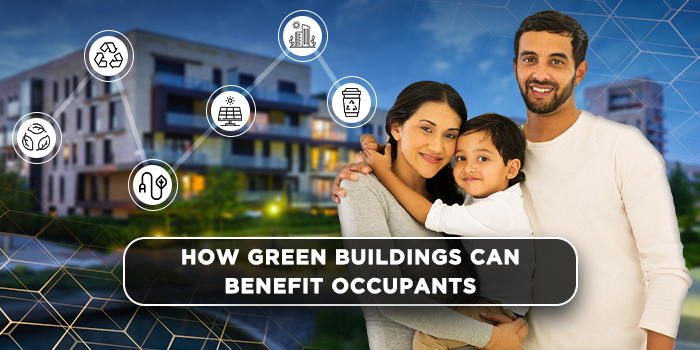

How Green Buildings can benefit occupants

Any structure erected with a conscious eye to reduce and eliminate to the extent possible the critical impacts of rising temperatures and climate change, thus extending positive impact on the environment, is a “green building”. This is achieved through efficient use of resources like water and energy, relying on sustainable and non-toxic materials, using processes of re-using and recycling and an adaptable design, among other methodologies including renewable sources of energy like solar power. Not just reduction of carbon footprints, worldwide, there’s growing evidence of multiple benefits that green buildings can provide to help create sustainable and thriving communities while boosting economic growth.

The global gold standard for green building certification systems is Leadership in Energy and Environmental Design or LEED, which follows a standard metric for all types of buildings through its various phases of construction, besides evaluating interiors, operations and maintenance and core and shell.

LEED has three layers of rating for green buildings, based on their features and design. The ratings are Platinum, Gold and Silver. In India, the certification for “green buildings” is given by the Indian Green Building Council (IGBC), which was formed as part of the Confederation of Indian Industry (CII) in 2001.

What is IGBC Ratings?

The Indian Green Building Council (IGBC), part of the Confederation of Indian Industry (CII) was formed in the year 2001. The vision of the council is, “To enable a sustainable built environment for all and facilitate India to be one of the global leaders in the sustainable built environment by 2025”.

The council offers a wide array of services which include developing new green building rating programmes, certification services and green building training programmes. The council also organises Green Building Congress, its annual flagship event on green buildings.

The council is committee-based, member-driven and consensus-focused. All the stakeholders of construction industry comprising of architects, developers, product manufacturers, corporate, Government, academia and nodal agencies participate in the council activities through local chapters. The council also closely works with several State Governments, Central Government, World Green Building Council, bilateral multi-lateral agencies in promoting green building concepts in the country.

How do occupants benefit from green buildings?

There are multiple ways in which the consumers/occupants benefit from a green building. These are some of the key advantages:

# Reduced maintenance and operation cost: Green buildings ensure efficient use of resources like water and electricity thanks to innovative construction methods. Through optimization of natural light and use of task-lighting strategy, power and water bills are cut by nearly one-third, thus increasing earnings.

# Better energy efficiency: Green buildings are designed to minimize reliance on energy from non-renewable sources like coal. Using solar panels and maximizing natural light with the help of specially designed windows, the use of artificial light is reduced drastically, thus saving on energy bills.

# Improves indoor air quality: By installing operable windows to allow maximum sunlight to filter through and reducing use of harmful and toxic materials, green buildings also offer superior indoor air quality, thus impacting the occupants’ health positively, besides improving illumination, ergonomics and thermal conditions inside the building.

# Enhances water efficiency: Green buildings vastly improve water efficiency by using practices like rainwater harvesting, reducing water wastage by installing efficient plumbing fixtures and deploying systems to purify and recycle waste water.

# Improves occupant health: Occupants of green buildings can enjoy a clutch of health benefits and a better quality of life thanks to the use of safe and sustainable materials, better indoor air quality, ergonomics, etc. Care is taken to avoid using building materials that may contain harmful volatile organic compounds (VOCs) or plastic by-products which could be toxic, sometimes emitting carcinogens which can raise the risk of cancer, respiratory diseases and other health conditions.

# Material efficiency: Green buildings are designed in a manner as to use less materials, water and energy. The materials are durable and the processes generate as little waste as possible, without compromising on the result. Some of the materials used can be recycled and reused.

# Creates better environment: Green buildings have a significant positive impact on the environment by relying more on non-polluting energy sources. By minimizing the levels of carbon dioxide emitted into the atmosphere, such structures can help slow down climate change.

# Eases load on local resources: By using technologies and processes that boost water and energy efficiency, green buildings can reduce the burden on local shared resources.

# More durable: Not only do green buildings offer energy and water savings and better indoor air quality, these structures are more durable as well, since sustainable materials have been proven to last longer. These materials endure for years exposed to the elements, while requiring minimal maintenance.

# Better workplace productivity: According to studies, employees working in green and well-ventilated office buildings are more productive, since they are more focused, have improved cognitive function, get better sleep and fall sick less frequently.

# A future-proof investment: Green buildings are regarded as future-proof investment because of their longevity, adaptability, resilience and capacity to improve the quality of life of its occupants, while positively impacting the environment. The trend will continue to grow, experts feel.

Disclaimer : Information contained and transmitted by us are for information purposes only. All views and/or recommendations are those of the concerned author personally and made purely for information purposes. Nothing contained in the articles should be construed as business, legal, tax, accounting, investment or other advice or as an advertisement or promotion of any project or developer or locality. Pioneer Property Management Ltd. does not offer any such advice. No warranties, guarantees, promises and/or representations of any kind, express or implied, are given as to (a) the nature, standard, quality, reliability, accuracy or otherwise of the information and views provided in (and other contents of) the articles or (b) the suitability, applicability or otherwise of such information, views, or other contents for any person’s circumstances. We shall not be liable nor shall be held responsible in any manner for any action taken based on the published information (whether in law, contract, tort, by negligence, products liability or otherwise) for any losses, injury or damage (whether direct or indirect, special, incidental or consequential) suffered by such person as a result of anyone applying the information (or any other contents) in these articles or making any investment decision on the basis of such information (or any such contents), or otherwise. The users should exercise due caution and/or seek independent advice before they make any decision or take any action on the basis of such information or other contents.
Warehouse automation – the Buzz-phrase

Warehouse automation is the process of substituting repetitive manual tasks with automated systems, the objectives being to minimize labour-intensive work, cut down on time consumed in moving inventory into, within and out of warehouses and free up manpower for more rigorous quality-control.

Warehouse automation can be both digital and physical.

# Digital automation resorts to use of data and software to minimize manual workflows.

# Physical automation uses technology like robots to reduce movement of staff, while building more efficient workflows.

How does automation improve warehouse efficiency?

Adoption of automated systems can result in:

# Reducing human error

# Cutting down on labour

# Improving coordination in material handling

# Improving safety at workplace

# Achieving better inventory control

# Elevating customer service level

# Cutting overall costs

# Increasing throughput

# Improving employee satisfaction

# Enhancing data accuracy & analysis

# Optimizing warehousing space

What are the different types of warehouse automation technology in use?

Warehousing technology aims at minimizing manual tasks, thus speeding up processes in the entire ecosystem, from receiving to shipping. The technologies most in use include: # Warehouse management systems or WMS: These are software applications which help in operations like monitoring, controlling and optimizing day-to-day operations. These operations would typically include inventory tracking, packing and shipping activities and coordinating handling machinery.

# Goods-to-Person: GTP fulfillment is a critical tool to raise efficiency. GTP systems can help increase the speed of warehouse picking manifold by cutting congestion with the help of conveyors, carousels, vertical lifts, etc.

# Automated Storage and Retrieval Systems (AS/RS): AS/RS comprises automated systems and tools like mini-loaders to store and retrieve stuff, vehicles for carrying materials and shuttles. AS/RS is extremely effective in space-constrained high-volume warehouse applications.

# Automatic Guided Vehicles (AGVs): Using magnetic strips, sensors or wires, AGVs navigate a fixed path through the warehouse. AGVs are tailored to serve simple yet large warehouse settings and aren’t suited to complex warehouses with space constraints and heavy human traffic.

# Autonomous Mobile Robots (AMRs): AMRs, on the other hand, can safely navigate through heavy human traffic in complex settings, using laser guidance systems to detect obstacles. These are much more flexible than AGVs, use GPS systems to negotiate routes through a particular warehouse and are easy to programme.

# Pick-to-Light and Put-to-Light Systems: These hi-tech systems direct warehouse pickers accurately to place or pick up specific items, using barcode scanning devices synced to digital light displays, thus minimizing search time and human error drastically.

# Voice Picking and Tasking: Also known as pick-by-voice, this system uses speech identification software and mobile headsets to create optimized pick paths to direct warehouse staff to their destinations for picking or putting away a product very accurately. It ensures improved safety and efficiency since there’s no need to carry handheld devices.

# Automated Sorting Systems: These systems help in fulfilling orders for receiving, picking, packing and shipping of materials by identifying items on a conveyor belt and directing those to a warehouse using barcode scanners, RFID and sensors.

# Predictive Maintenance: Predictive or preventive maintenance systems are designed to monitor equipment to detect possible defects before they occur, rather than having to repair them once there’s a breakdown. These systems take preventive measures by automatically slotting corrective maintenance.

# Fleet Management Systems: This comprises monitoring and managing the company’s vehicles deployed to ensure maximum productivity, while rationalizing operational costs. This is done by collecting and analyzing data from vehicles including speed, fuel consumed, run time, etc.

Disclaimer : Information contained and transmitted by us are for information purposes only. All views and/or recommendations are those of the concerned author personally and made purely for information purposes. Nothing contained in the articles should be construed as business, legal, tax, accounting, investment or other advice or as an advertisement or promotion of any project or developer or locality. Pioneer Property Management Ltd. does not offer any such advice. No warranties, guarantees, promises and/or representations of any kind, express or implied, are given as to (a) the nature, standard, quality, reliability, accuracy or otherwise of the information and views provided in (and other contents of) the articles or (b) the suitability, applicability or otherwise of such information, views, or other contents for any person’s circumstances. We shall not be liable nor shall be held responsible in any manner for any action taken based on the published information (whether in law, contract, tort, by negligence, products liability or otherwise) for any losses, injury or damage (whether direct or indirect, special, incidental or consequential) suffered by such person as a result of anyone applying the information (or any other contents) in these articles or making any investment decision on the basis of such information (or any such contents), or otherwise. The users should exercise due caution and/or seek independent advice before they make any decision or take any action on the basis of such information or other contents.

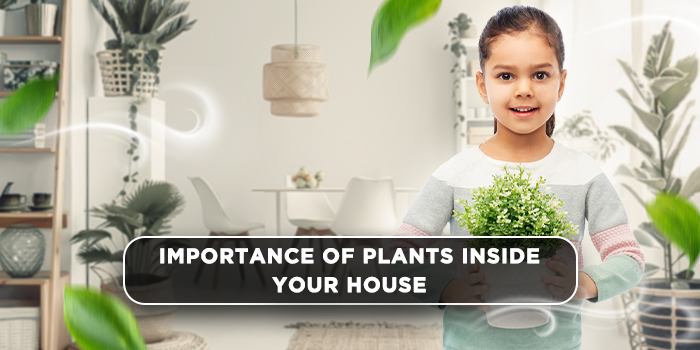
Importance of Plants inside your House

Indoor plants not only make our house look better, they have the ability to make us feel good as well. Research shows indoor gardening can boost our mood, concentration, creativity and productivity, while reducing stress and fatigue and cleaning indoor air by removing toxins and producing oxygen, thus even promoting recovery

Clearly, plants bring home much more than simply ornamental value, as our ancestors had always known. Having plants at home creates a deep sense of bonding as we tend to them, which in turn is soothing and healing.

These are some of the inherent scientific benefits of having indoor plants in our house:

# Reduces stress: A study published in the Journal of Physiological Anthropology found plants in our home can be soothing and make us feel more relaxed and comfortable

# Makes us happier: Indoor plants can actually make us feel happier and promote a sense of well-being by replicating in some way the feeling of a walk in the park. They can alleviate mental fatigue and even improve our cognitive abilities

# Can be therapeutic: Indoor plants can also provide us with horticultural therapy by helping reduce symptoms in conditions like anxiety, depression and dementia, among others. They also help lower blood pressure and reduce muscle tension

# Improves concentration: Tending to potted plants in our home are known to increase our attention span and improve levels of concentration

# Helps in recuperation: While recuperating from a bout of illness or any medical procedure, having indoor plants around us can speed up the recovery process by generating a feel-good sensation, according to scientists

# Boosts productivity: A clutch of studies have revealed that plants around you can promote both productivity and innovation

# Improves ambient environment: Plants not only make our house look prettier and greener, they also improve indoor air quality through photosynthesis, transpiration and by increasing humidity. Indoor plants can also eliminate volatile organic compounds and clean up the air at home

# Injects positivity: Plants at home buoys us with a sense of positivity which can help make us appreciate the things in our lives and enjoy our work more

# Helps prevent allergies: Houseplants have the ability to lower the risk of allergies, particularly among children

# Antidote for cigarette smoke: Some houseplants like Peace Lily plant, can filter toxins present in cigarette smoke, thus ridding the house of smoke odours and pollutants

# Can improve indoor acoustics: Indoor plants can absorb background noise and improve the acoustics in our home. A great reason to go houseplant hunting, particularly if you are a music buff…

“The green family adds the quotient to any built space to make it more humane. The rigidity and hardness of concrete columns and beams, brick walls, plasters and various items of furniture in an enclosure is softened by adding the touch of Hooker’s Green or Viridian Hue from any foliage strategically positioned within that particular space. Apart from being an excellent natural purifier of the surrounding air, the richness of the hues and shades, changing canopy radius, varying profiles of stems and trunks make it the most effective source of live, natural art form to enhance the quality of all habitable spaces.”
Sailangi Mukherjee, Architect and Urban Designer.

# Promotes sleep: Houseplants can help us sleep better by improving the air quality in our bedroom and producing more oxygen. So those of us with a sleep disorder can very well consider keeping potted plants in the bedroom

# Reduces headaches: Research shows that plants can help eliminate benzene and formaldehyde from the air. So, by purifying indoor air, houseplants can also combat common headaches caused by some of these impurities

# Fights common cold: Having indoor plants in our home can help us minimize chances of catching a common cold or suffering from a blocked nose significantly by increasing humidity and removing airborne dust particles.

Disclaimer : Information contained and transmitted by us are for information purposes only. All views and/or recommendations are those of the concerned author personally and made purely for information purposes. Nothing contained in the articles should be construed as business, legal, tax, accounting, investment or other advice or as an advertisement or promotion of any project or developer or locality. Pioneer Property Management Ltd. does not offer any such advice. No warranties, guarantees, promises and/or representations of any kind, express or implied, are given as to (a) the nature, standard, quality, reliability, accuracy or otherwise of the information and views provided in (and other contents of) the articles or (b) the suitability, applicability or otherwise of such information, views, or other contents for any person’s circumstances. We shall not be liable nor shall be held responsible in any manner for any action taken based on the published information (whether in law, contract, tort, by negligence, products liability or otherwise) for any losses, injury or damage (whether direct or indirect, special, incidental or consequential) suffered by such person as a result of anyone applying the information (or any other contents) in these articles or making any investment decision on the basis of such information (or any such contents), or otherwise. The users should exercise due caution and/or seek independent advice before they make any decision or take any action on the basis of such information or other contents.